
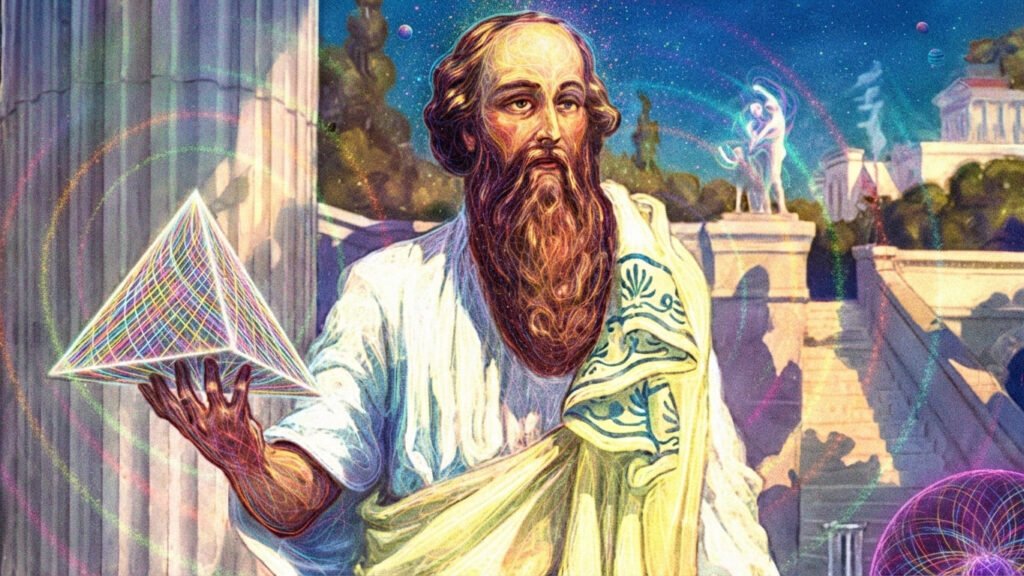
The Quadrivium of Pythagoras
The understanding of the cosmos as an ordered entity, governed by immutable mathematical laws and harmonic vibrations, constitutes one of the most profound legacies of the Pythagorean tradition. The Quadrivium, or the "way of four paths," represents not only an educational curriculum from Antiquity and the Middle Ages, but a true cosmogony that seeks the elevation of the soul from the world of sensory appearances to the intelligible reality of being. This system, based on arithmetic, music, geometry, and astronomy, proposes that reality, at its deepest level, is mathematical in nature and that the disinterested study of these disciplines leads to spiritual purification or catharsis.
In the context of a renewed musical education, such as that being promoted today, the Quadrivium emerges not as a historical relic, but as a vibrant tool for expanding consciousness. Through the lens of harmony, human beings can reconnect with the secrets of beauty that define their relationship with nature and the infinite universe.
The Ontological Foundation: Everything is Number
The central premise of Pythagorean thought is summarized in the statement that number is the principle (archéof all things. Unlike the Ionian philosophers who sought a material substance such as water or air, Pythagoras postulated that numbers are the very essence of reality. This view suggests that all bodies consist of points or units in space which, when organized under the laws of the limit, constitute the structure of existence.
The doctrine stems from a dialectical tension between the unlimited (apeiron) and the limit (pearsAccording to the school's thinking, influenced by Anaximander's notions of infinite substance, the universe acquires form and order through the imposition of a numerical structure on primordial chaos. In this way, nature in the world became harmonious from the conjunction of limitations and limitations.
Pythagorean ideology is based on a series of numerical categories that have a profound metaphysical implication:
- Monad (The Unit): It represents the unmanifest Being, being the origin of all multiplicity and a symbol of the divine.
- Dyad (The Duality): It symbolizes the splitting of the point, which is the origin of opposites and polarity in the universe.
- Triad (The Trinity): It embodies the balance that arises from the union of the monad and the dyad, representing the different levels of the world.
- Tetrad (The Quaternary): It signifies the manifestation of reality in the material world through the four elements.

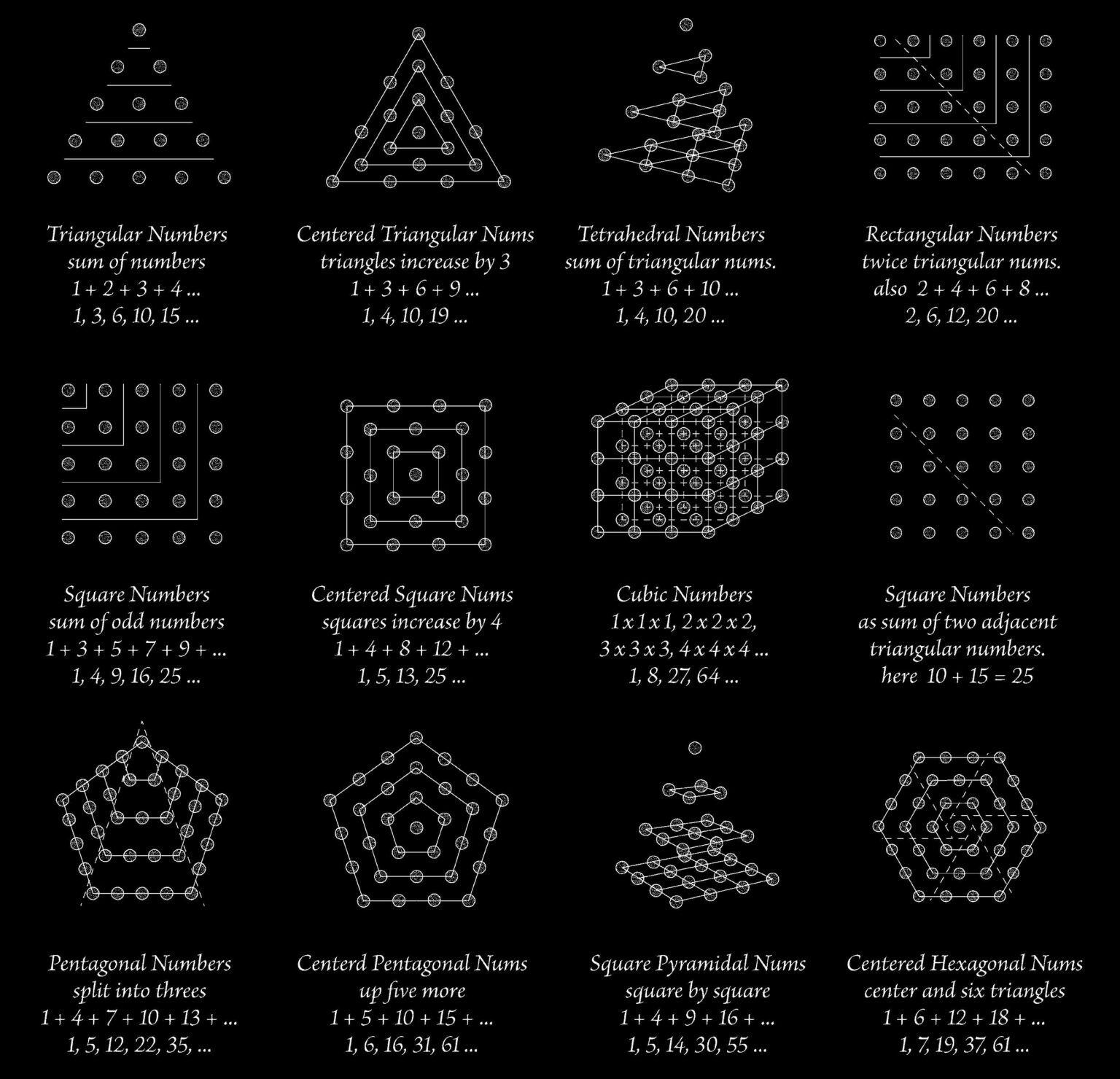
The number ten, represented by the Tetraktys, is the image of the whole in motion. This figure of ten points arranged in a triangle of four rows ($1+2+3+4=10$) contains within itself the proportions of musical consonances and the geometric structure of three-dimensional space.7 The Tetraktys functioned as a mystical symbol upon which initiates made their oaths, recognizing in it the source and root of eternal nature.3
The Structure of Knowledge: The Four Paths of Mathesis
The systematization of mathematical disciplines in what we know today as the Quadrivium was a process that was consolidated over centuries, reaching a precise technical definition with Nicomachus of Gerasa and, later, with Boethius. These sciences are divided according to their object of study, based on the distinction between quantity (the discrete) and magnitude (the continuous).
Arithmetic is considered the root and mother of the other three disciplines. According to Nicomachus, arithmetic naturally precedes geometry, music, and astronomy, because if number is eliminated, figures and proportions are eliminated, but the abolition of figures does not destroy the existence of number.
The four mathematical disciplines of the Quadrivium are divided according to their object of study, based on the distinction between quantity (discrete) and magnitude (continuous):
- ARITHMETIC:
- Subject of Study: Absolute quantity (multitude per se).
- Ontological Dimension: The number itself, exploring its properties and essences.
- MUSIC:
- Subject of Study: Relative quantity (multitudo ad aliquid).
- Ontological Dimension: Number in relation, manifested as harmony and proportion.
- GEOMETRY:
- Subject of Study: Resting magnitude (magnitude of real estate).
- Ontological Dimension: Number in space, analyzing shapes and perfect solids.
- ASTRONOMY:
- Subject of Study: Moving magnitude (magnitude of mobilis).
- Ontological Dimension: The number in space-time, centered on the movement of the stars.
These disciplines act as bridges or ladders that take the mind from objects apprehended by the senses to realities understood by the intellect. Boethius argues that no one can achieve the perfection of philosophy without investigating the nobility of this wisdom through the four parts of mathematics.
Arithmetic: The Dance of Unity and Multiplicity
Pythagorean arithmetic should not be confused with mere commercial calculations or logistics. It is a science that explores the intrinsic qualities of numbers and their capacity to generate order in the cosmos. In the De Institutione Arithmetica From Boethius, it is emphasized that the things that "truly are" are those that do not grow or diminish, remaining immutable in their essence; these incorporeal realities are what arithmetic seeks to unravel.
The study covers the generation of even and odd numbers, perfect numbers (those that are equal to the sum of their divisors), amicable numbers, and the mystique of polygonal numbers. The discovery of the incommensurability of the diagonal of a square (the square root of two) marked a milestone in the history of thought, revealing that there are dimensions of reality that escape all reason, but that follow precise geometric laws.
Music: The Dynamic Application of Proportion
Music is the tangible manifestation of numerical order. Pythagoras is credited with the first historical application of mathematics to describe laws of nature by discovering the foundation of musical consonance. The anecdote of the hammers in the blacksmith's shop illustrates this discovery: upon hearing the hammer blows, Pythagoras noticed that the concordant sounds corresponded to weights that bore simple mathematical ratios to each other.
Through the use of the monochord, the ratios of the fundamental intervals that govern universal harmony were established.:
- The Octave (Tuning Fork): 2:1 ratio. Divides the string in half, producing the same pitch in a higher register.
- The Fifth (Diapente): Ratio of 3:2. Represents a relationship of balance and creative tension.
- The Fourth (Diatessaron): Ratio of 4:3. The interval that completes the scale structure.
These proportions utilize the first four numbers of the Tetraktys (1, 2, 3, 4), demonstrating that musical harmony is a direct extension of sacred arithmetic. Boethius expanded upon this view by classifying music into three levels: musica mundana (the harmony of the celestial spheres and elements), musica humana (the balance between soul and body), and musica instrumentalis (the sound produced by instruments or the voice).
Harmonic SeriesVibration and order in the structure of energy and matter.
Geometry: Form as a Creative Language
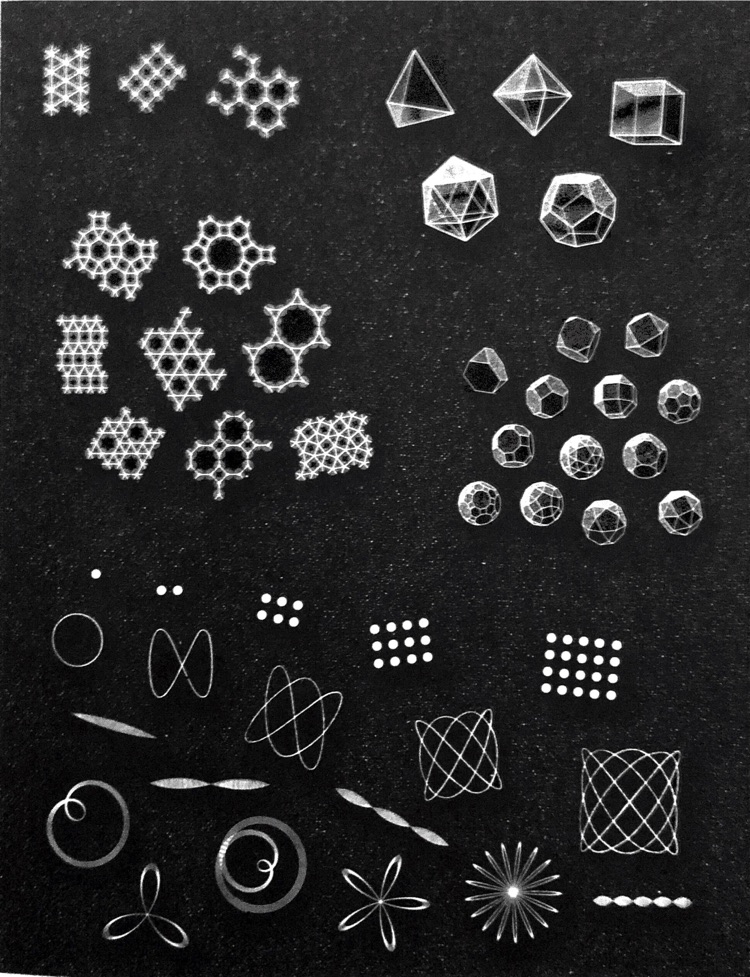
Geometry is the study of number in static space. For the Pythagoreans, the universe is an ordered unity centered around a central point, where the elements harmonize to form the cosmos. The demonstration of the existence of only five regular polyhedra or Platonic solids is one of the greatest contributions of this school to the understanding of the structure of matter.
- Tetrahedron (4 triangles): Associated with FireIt represents light, heat, and upward energy.
- Hexahedron or Cube (6 squares): Associated with the LandIt symbolizes stability, solidity, and the material world.
- Octahedron (8 triangles): Associated with AirIt represents fluidity, communication, and space.
- Icosahedron (20 triangles): Associated with WaterIt symbolizes cohesion, change, and adaptability.
- Dodecahedron (12 pentagons): Associated with Ether/CosmosIt is the quintessence that encompasses and unifies the universe.
The Sacred geometry is understood as an ancient language that reveals the templates that give rise to all creation, from the microcosm of atoms to the macrocosm of galaxies. The study of the golden ratio (phi = 1.618...) in Greek geometry and art reflects the search for a beauty that imitates the divine order of nature.
Astronomy: The Music of the Spheres and Time
Astronomy, understood as a moving magnitude, studies number in space-time. The Pythagoreans postulated a revolutionary astronomical system where the Earth and the planets move around a central fire, deducing that this movement must produce an ineffable sound. This "harmony of the spheres" is not perceptible to the ordinary human ear because we are immersed in it from birth, like the blacksmith who gets used to the noise of his own hammer.
It was believed that the distances between the planets were in proportions identical to musical intervals, making the universe a colossal lyre. Astronomy in the Quadrivium is not only physical observation, but the study of planetary resonance and the cycles that govern life on Earth.
At Legatto we developed an app so you can see the harmony of these celestial bodies for yourself.
The Catharsis Process: Purification through Knowledge
According to history, the ultimate goal of the Quadrivium is not the technical mastery of mathematics, but the purification of the soul. In the Pythagorean tradition, the soul is a divine entity trapped in the cycle of reincarnations (metempsychosis) due to an original agreement. "Salvation" is achieved through catharsis, which is not limited to external rites, but is achieved through the deep study of universal harmony.
- Intellectual Catharsis:
- Method: Study of the Quadrivium.
- Result: Elevation of the mind from the senses to intelligible ideas.
- Moral Catharsis:
- Method: Adoption of a code of conduct and the practice of silence.
- Result: Development of temperance and mastery of the passions.
- Aesthetic Catharsis:
- Method: Contemplation of harmony.
- Result: To achieve harmony with the cosmic order and universal beauty.
- Physical Catharsis:
- Method: Diet and exercise.
- Result: Purification of the body, the vehicle of the soul.
Intellectual pursuits in the liberal arts draw the soul away from bodily passions and orient it toward the eternal. Pure science is, therefore, a mystical path. The Pythagoreans used music as a medicine for the spirit, employing specific chants and rhythms to calm anger, heal illnesses of the soul, and maintain inner harmony.
The conduct of the initiate was governed by strict rules that sought to maintain the purity necessary to access the mysteries. The idea that the "theoretical" or contemplative life is the highest good profoundly influenced Plato and Aristotle, laying the foundations of Western ethics.
Historical Evolution and Preservation of Knowledge
The transition of the Quadrivium from the school of Pythagoras to medieval education is a testament to the resilience of this system. Nicomachus of Gerasa, in the 2nd century CE, revitalized interest in Pythagorean arithmetic as a foundation for philosophy. Later, Boethius translated and adapted these works into Latin in the 6th century, creating the term "Quadrivium" and establishing the educational standard for Latin Christendom.
Saint Isidore of Seville, in the 7th century, integrated these arts into his Etymologiesarguing that no discipline can be perfect without music, since harmony is present in all things. Under the reform of Alcuin of York in the empire of Charlemagne, the Trivium and the Quadrivium became the "seven liberal arts", the foundation of the cultural instruction of medieval man.
This legacy allowed the Pythagorean vision of a mathematical and harmonious reality to influence art, the architecture of Gothic cathedrals, and the birth of modern science during the Renaissance.
The Quadrivium Today: Musical Awareness and New Paradigms
In the 21st century, the Quadrivium reemerges as a response to the need for an education that transcends mere technique and focuses on sensitivity and critical thinking. Proposals such as those from Legatto Harmony & Music Institute They seek to merge traditional schools with contemporary innovation, using music and sacred geometry as tools for self-knowledge and transcendence.
Modern research explores themes that resonate with ancient Pythagorean intuition, such as the influence of harmonics on matter (cymatics), the role of the golden ratio in musical harmony, and the impact of frequencies like 432 Hz on human well-being. This holistic vision proposes that music is consciousness in vibration and that, by understanding its codes, we can harmonize our environment.
The pillars of this contemporary education reflect a synthesis of the Quadrivium adapted to the "New World":
- Proportion: The relationship with the universe and beauty through geometry and cymatics.
- Harmony: The resources of perception and their conscious use in musical language.
- Appreciation: The cultural history and emotional language of sounds.
- Technology: Modern production tools that respect the laws of acoustics.
- Instrument and Composition: The expression of universal harmony through being.
The study of figures such as Ervin Wilson and his microtonal tuning systems extend the Pythagorean exploration into new mathematical and sonic horizons, keeping alive the flame of disinterested research.
Conclusion: The Path Back to Universal Harmony
The Pythagorean Quadrivium is not simply a set of academic disciplines, but an invitation to experience the unity of the cosmos. By recognizing that number governs all things and that harmony is the principle that unites diversity, humankind finds its place in the dance of the spheres. The study of these arts allows the soul to rise above the mundane, achieving a peace and prosperity that arise from being in resonance with natural laws.
In this "Here and Now," the Pythagorean legacy reminds us that beauty is not accidental, but rather woven into the very fabric of reality. Reclaiming the spirit of the Quadrivium is, ultimately, reclaiming our own capacity to be harmonious, wise, and free. Music, as the universal language of harmony, remains the most direct bridge to that state of consciousness where the individual and the universe recognize each other as one.
Quotes
- Boethius - from Institutione Arithmetica | PDF - Scribd, accessed January 4, 2026, https://www.scribd.com/document/617555620/Boethius-De-Institutione-Arithmetica
- Figuring Out the Quadrivium: Math and Science Education in Sayers and the Classical Tradition - Classis, accessed January 4, 2026, https://classicalchristian.org/classis/figuring-out-the-quadrivium-math-and-science-education-in-sayers-and-the-classical-tradition-2/
- Pythagoras - Wikipedia, the free encyclopedia, accessed January 4, 2026, https://es.wikipedia.org/wiki/Pit%C3%A1goras
- “THE PYTHAGOREAN THEOREM. PROOFS AND DIDACTIC CONSIDERATIONS FOR ITS TEACHING” 1 - Virtual Library, accessed January 4, 2026, http://bibliotecavirtual.dgb.umich.mx:8083/jspui/bitstream/DGB_UMICH/11802/1/FISMAT-L-2007-0050.pdf
- Legatto - Music School in Mexico - Home Page, accessed January 4, 2026, https://legatto.space/
- About us - Legatto Space, accessed January 4, 2026, https://legatto.space/en/nosotros/
- Pythagoreans - Wikipedia, the free encyclopedia, accessed January 4, 2026, https://es.wikipedia.org/wiki/Pitag%C3%B3ricos
- The Logic of Opposition in the Physics of Anaximander, Pythagoras, and Heraclitus. Gustavo Fernández Pérez. IES. Isabel de Ca, accessed January 4, 2026. https://revistascientificas.us.es/index.php/themata/article/download/496/461
- The music of the spheres, do the heavens resonate?, accessed January 4, 2026, https://ri.unsam.edu.ar/bitstream/123456789/313/1/TLIC_ESHUM_2017_DLC.pdf
- The murder of Pythagoras | Matemerce, accessed January 4, 2026, https://matemerce.files.wordpress.com/2016/04/el_asesinato_de_pitagoras_-_marcos_chicot.pdf
- pythagoras - Dialnet, accessed January 4, 2026, https://dialnet.unirioja.es/descarga/articulo/6463494.pdf
- Pythagoras and the Quadrivium from Late Antiquity to the Middle Ages - Brill, accessed January 4, 2026, https://brill.com/downloadpdf/book/edcoll/9789004499461/BP000011.pdf
- Boethius's anthropology in De Institutione Musica and Contra ..., accessed January 4, 2026, https://revistas.ucm.es/index.php/RESF/article/download/61385/4564456553081/4564456582991
- Nicomachus, Arithmetic - Classical Liberal Arts Academy, accessed January 4, 2026, https://classicalliberalarts.com/nicomachus-arithmetic/
- Saša Popovic DE INSTITUTIONE MUSICA: BOETHIUS' ANCIENT ..., accessed January 4, 2026, http://elib.mi.sanu.ac.rs/files/journals/zr/29/zrn29p125-154.pdf
- Nicomachus - Wikiquote, accessed January 4, 2026, https://en.wikiquote.org/wiki/Nicomachus
- ANCIENT PYTHAGOREANISM - Philosophical Studies, accessed January 4, 2026, https://estudiosfilosoficos.dominicos.org/ojs/article/download/362/944/875
- JOHN OF SALISBURY AND BOETHIUS ON ARITHMETIC - Cambridge University Press, accessed January 4, 2026, https://www.cambridge.org/core/services/aop-cambridge-core/content/view/11C7638EBD81CA93375A32344C41CC94/S0143045900003288a.pdf/div-class-title-john-of-salisbury-and-boethius-on-arithmetic-div.pdf
- Biography of mathematicians: Pythagoras (16 of 18) The Pythagorean Quadrivium., accessed January 4, 2026, https://virtual.uptc.edu.co/ova/estadistica/docs/autores/pag/mat/Pitagoras16.asp.htm
- Pythagorean Model | PDF | Universe | Pythagoras - Scribd, accessed January 4, 2026, https://fr.scribd.com/document/581361322/MODELO-PITGORICO
- Scientific Harmony of the Pythagoreans | Miguel de Guzmán Chair, accessed January 4, 2026, https://blogs.mat.ucm.es/catedramdeguzman/armonia-cientifica-de-los-pitagoricos/
- Pythagorean aesthetics, a metaphysical aesthetics - New Acropolis Library, accessed January 4, 2026 https://biblioteca.nueva-acropolis.es/2012/la-estetica-pitagorica-una-estetica-metafisica/
- Renaissance science – XLIII, accessed January 4, 2026, https://thonyc.wordpress.com/2022/09/15/renaissance-science-xliii/
- The Platonic Solids "Sacred Geometry" - YouTube, accessed January 4, 2026, https://www.youtube.com/watch?v=mUO9p9EVhcU
- Blog - Legatto Space, accessed January 4, 2026, https://legatto.space/en/blog/
- PYTHAGORAS and the MUSIC OF THE SPHERES.
 | Music and Mathematics in Ancient Greece.
  - YouTube, accessed January 4, 2026, https://www.youtube.com/watch?v=ejrdKjn1B8k
 - Chapter 1 Pythagoras and the Quadrivium from Late Antiquity to the Middle Ages in - Brill, accessed January 4, 2026, https://brill.com/display/book/edcoll/9789004499461/BP000011.xml
- Research - Legatto Space, accessed January 4, 2026, https://legatto.space/en/investigacion/
- PORPHYRIUS LIFE OF PYTHAGORAS ARGONAUTIC ORPHIC HYMNS | José Francisco Escribano Maenza, accessed January 4, 2026, https://josefranciscoescribanomaenza.files.wordpress.com/2018/05/porfirio-vida-de-pitagoras-argonauticas-orficas-himnos-orficos.pdf
- Saint Isidore as a music theorist: classical heritage and Visigothic tradition - MusicaAntigua.com, accessed January 4, 2026 https://musicaantigua.com/san-isidoro-como-teorico-musical-herencia-clasica-y-tradicion-visigoda/
- The seven liberal arts: Trivium et Quadrivium - Dialektika, accessed January 4, 2026, https://dialektika.org/las-siete-artes-liberales-trivium-et-quadrivium/
- Liberal Arts - Encyclopaedia Herder, accessed January 4, 2026, https://encyclopaedia.herdereditorial.com/wiki/Artes_liberales
- The Seven Liberal Arts. - Hans Betancourth, accessed January 4, 2026 https://hansbetancourth.com/las-siete-artes-liberales/

[…] tempered” (1) so that it could play in all keys. In this narrative, Pythagoras is usually credited with the discovery of the fundamental intervals (the perfect fifth, the fourth, the octave) and the basis […]