

Music that is not written: oral tradition and collective memory
Oral tradition · Music · Collective memory
There are songs that never needed sheet music to transcend centuries. Someone heard them. Remembered them. Sang them again. Another person did the same. And so, from one person to another, a piece of music achieved something extraordinary: surviving while continuing to evolve.
There's a library that has no shelves. Breathe.
It's in the throat of a woman who still remembers a melody she learned as a child. It's in the hands of someone who knows a variation that was never written down. It's in the exact moment a group knows when to come in after a breath, even though no one has counted to four.
In that library, you don't ask for a book. You ask for: “Sing it to me again.”
Then someone tries to repeat it.
Perhaps she changes a note. Perhaps she keeps the outline but lengthens the ending. Perhaps she sings it with a different accent, in another city, for another generation.
And, mysteriously, the song remains recognizable. The thread continues.
Music existed first as an event
A vast amount of human music has circulated outside of written notation. Before a melody could be stored in a digital file, before the record, before many of the notation systems we use today, there were already people capable of preserving repertoires, stories, rhythms, and musical forms through listening and repetition.
And that form of transmission remains active.
The UNESCO describes oral traditions as vehicles for transmitting knowledge, cultural and social values, and collective memory. They include songs, chants, epic poems, stories, performances, and many other forms that exist as long as someone knows how to perform them and someone else can learn them.
The word oral It might make us think only of the mouth. In music, the phenomenon is much broader. We also learn by looking at fingers, perceiving weight, copying an articulation, entering alongside other bodies, recognizing a timbre, following a gaze, or understanding when a song corresponds to a certain moment in life.
Orality constitutes an infrastructure.
Body
Breathing, muscle memory, coordination, pronunciation, gestures, movement, articulation, and ways of producing sound.
Relationship
Someone demonstrates, someone listens, someone imitates, someone corrects. Transmission happens between people.
Context
A musician also learns where they live: celebrations, work, rituals, meetings, mourning, dance, play, territory and community.
“The archive isn’t always in a library. Sometimes the archive breathes.”
Remembering a song doesn't always mean copying it.
Herein lies one of the most fascinating differences between a fixed work and a living tradition.
Imagine a melody that is passed down through five generations. Our modern intuition might lead us to search for an original version and compare the others against it: what notes changed? what was lost? who played it correctly?
An oral tradition can operate with a different logic.
UNESCO itself points out that many oral expressions combine reproduction, improvisation and creation.Their versions change with each narrator or performer. That variation can be part of the vitality of the tradition.
Something similar profoundly transformed the study of epic poetry. During the 20th century, Milman Parry and Albert Lord studied oral tradition singers in the Balkans. Lord's work, published in The Singer of Tales, showed how an oral poet could compose while performing,working with formulas, themes and structures acquired through years of listening and practice.
The interpreter possessed a language. He knew possible paths within that language.
Thus, the memory could preserve an architecture without needing to save each execution as a photocopy.
1. Listen
Music first enters as an experience: sound, gesture, situation, emotion and coexistence.
2. Imitate
The person reproduces what they can. The ear begins to recognize patterns, phrases, structures, and ways of doing things.
3. Internalize
The song ceases to feel like external information. It begins to form part of its own musical vocabulary.
4. Vary
Decisions emerge. Some belong to shared conventions; others arise from the interpreter and the moment.
5. Retransmit
A new person receives the tradition. They keep the thread going and, at the same time, begin another chapter.
This changes a fundamental question.
Instead of just asking “"How does memory manage to store all those notes?"”,We can ask:
What does a musician really need to remember for a piece of music to live on?
A song that evokes memories of Michoacán
Let's go back to Mexico.
In Purépecha communities of Michoacán there is a musical form called pirekua.
It can be sung solo, in a duet, trio, or choir, accompanied by various instrumental ensembles. Its lyrics can deal with love and courtship, religion, historical events, and social or political thought.
But to say that pirekua is only a collection of songs would leave out much of what makes it significant.
UNESCO explains that the Pirériecha, The performers are recognized for their creativity and their unique interpretations of traditional songs. They can also act as social mediators: song serves as a space for communication between families and communities.
For generations, that knowledge has been passed down. primarily orally.
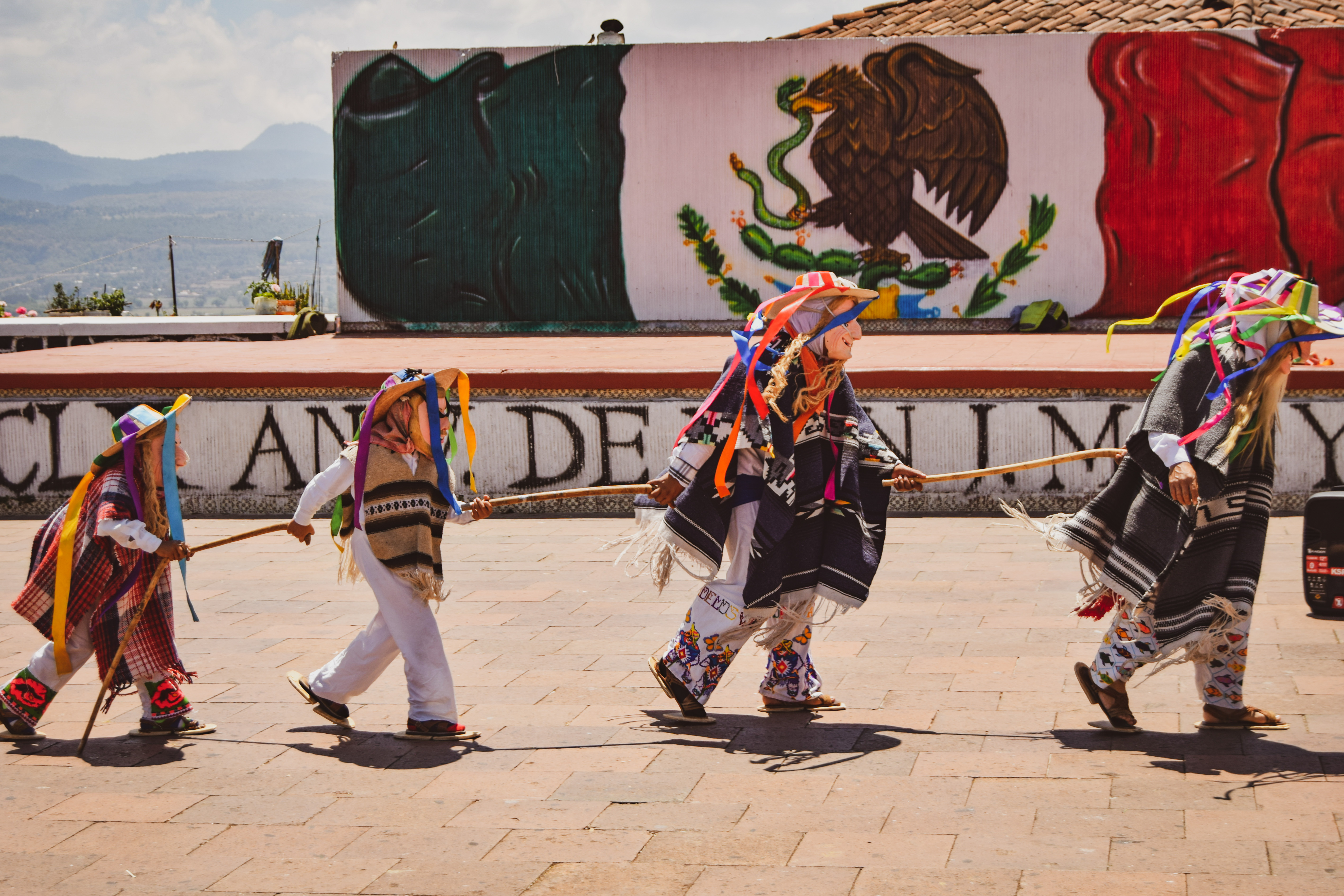
Let's think about what this implies.
A song can tell of something that happened in a community. Then another voice learns it. Sings it at another time. In doing so, the story begins to circulate again.
Memory becomes sound.
And sound can once again become conversation.
Pirekua was inscribed by UNESCO in 2010 on the Representative List of the Intangible Cultural Heritage of Humanity. Today, oral transmission, writing, and recordings coexist. This coexistence demonstrates something important: an oral tradition can adopt new tools without necessarily abandoning its historical forms of learning.
The challenge arises when fewer people want to continue the process. In 2024, UNAM Science documented the concern about a decrease in the practice of pirekua among younger generations in some communities.
A recording can remain intact on a server.
A tradition needs someone to revive it.
The historian who plays
In several West African societies we find figures known by terms such as jali, jeli or griot: musicians, storytellers and custodians of genealogies and histories.
UNESCO specifically uses African griots as an example of professional interpreters who can act as guardians of collective memory.
In this tradition, storytelling and playing can become a single act. A genealogy can travel within a song. A story can enter accompanied by the strings of a kora.
The catalogue of Smithsonian Folkways dedicated to Gambian jali Foday Musa Suso It shows something particularly revealing: within the same musical universe, stories related to the ancient Mali Empire appear, as well as compositions about contemporary events, including the human arrival on the Moon.
Memory receives the present.
Tradition continues to be written without ceasing to be tradition.

Stories that can take days to finish
In the mountains of northern Luzon, among the Ifugao communities, there exist the Hudhud: extensive sung narratives historically linked to the rice cultivation cycle and certain funeral ceremonies.
UNESCO documents more than two hundred accounts, each composed of numerous episodes. A full interpretation can take several days.
Now let's imagine the amount of memory involved.
Characters. Sequences. Formulas. Images. Repetitions. Melody. Language. Conventions that indicate how to continue.
The main storytellers have traditionally been older women, whose role goes beyond that of “singers”: their knowledge is connected to the history, culture and practices of the community.
The Hudhud makes evident something that a definition of "song" can obscure: Music can also be a way of organizing knowledge.

How can so much information fit inside one person?
It would be tempting to look for a single neurological answer.
Something like: The melody helps us remember better.
The reality is more interesting.
Some experiments have found that rhythm can function as a structure for recalling text under certain conditions. Other studies show that the advantages of singing over speaking depend on tempo, familiarity, and task design.
The available evidence suggests avoiding a simplistic formula such as "putting information into music guarantees remembering it".
Oral traditions build much richer systems.
There is repetition, of course. There are also predictable patterns, formulas, redundancy, metrics, social participation, years of practice, emotion, context, body movements, community responsibilities, and situations in which knowledge is reused.
We remember best what we need again.
And a living tradition creates occasions to need its memory.
“In oral tradition, remembering can mean reconstructing a familiar form in the present.”
Australia · territory and transmission
What if a map could be sung?
In various Australian Aboriginal cultures there are networks of songs related to territory, ancestors, relationships, ecological knowledge and cultural practices that are usually described in English using the term songlines.
He Australian Institute of Aboriginal and Torres Strait Islander Studies (AIATSIS) It explains how certain repertoires can encode genealogies, kinship relations, knowledge of the territory, social norms, and other knowledge.
One of the cases documented by AIATSIS is The Marlaloo Songline.The cycle had not been sung for over forty years. The elders who preserved this knowledge feared it might disappear and chose younger members to continue certain cultural responsibilities.
This example also requires clarification: knowing of the existence of a tradition does not mean possessing the right to reproduce it. Some knowledge has specific protocols, custodians, levels of access, and authorities.
The body also writes
Let's think now about a musical score.
It can indicate pitches. Durations. Meter. Dynamics. Articulations. Entries. Repetitions.
It's an extraordinary technology.
But a musical score never comes to music on its own.
Someone has to know how to read the signs and turn them into action. That person already brings with them a culture of interpretation: an idea of tuning, a relationship with the pulse, ways of phrasing, gestures, acceptable sounds, desired sounds, instrumental habits, and learned expectations.
The ethnomusicologist Floris Schuiling proposes in “Notation Cultures” Studying notation as part of specific musical cultures: their graphic systems also participate in the way a community imagines, learns, and produces music.
There are even traditions where written and oral transmission have been intertwined for centuries. Research on Ethiopian Christian chant,For example, they show how the memorization of melodic patterns and written sign systems work together.
So perhaps it's a good idea to abandon an overly rigid boundary between "oral music" and "written music".
Many types of music inhabit both worlds.
| Medium | What it can preserve especially well | What does it take to become a musician again? |
|---|---|---|
| Score | Symbolic relationships of height, rhythm, structure, articulation, and other instructions. | A culture of reading and interpretation. |
| Recording | A specific performance: timbre, tempo, tuning, space, nuances and synchronization. | A listener capable of contextualizing and, if desired, transforming what has been heard back into practice. |
| Oral transmission | Patterns, repertoire, ways of playing, pronunciation, gesture, variation and immediate correction. | Contact between people and continuity of practice. |
| Community | Functions, meanings, occasions, responsibilities and relationships surrounding music. | People who consider that knowledge relevant and continue to put it into action. |
A tradition can be preserved by changing
In Bangladesh and West Bengal we find another revealing example: the songs of the Trunk.
Their philosophy is largely transmitted through songs. Teachers use them to instruct their students, and the repertoire has traditionally been passed down orally.
UNESCO highlights something seemingly paradoxical: the language of these songs has been modernizing.
That helps keep them understandable and relevant.
Fidelity to a tradition can consist, in certain contexts, of preserving a relationship, a principle, or a way of doing things while some words, arrangements, or interpretations are transformed.
Tradition has movement because the people who uphold it are also alive.
Oral tradition never disappeared from modern music
We can walk into a jazz jam session and observe the same principle under completely different circumstances.
Musicians can read music perfectly. They can study harmony, arrangements, and transcriptions.
And yet, a crucial part of language is learned by listening: solos, records, teachers, colleagues, concerts, informal sessions, and years of interaction.
In his monumental study Thinking in Jazz,Paul Berliner documented, based on more than fifty professional musicians, the multiple ways —auditory, visual, kinetic, verbal, theoretical and emotional— through which improvisers construct their language.
The musician hears a phrase. He copies it. He transports it. He alters it. He discovers where it works. He mixes it with a hundred more phrases.
One day that phrase appears within a single and it becomes impossible to say exactly where what has been learned ends and where one's own voice begins.
That's also musical memory.
Then came a machine capable of remembering for us
The recording radically changed our relationship with the musical past.
For the first time, a performance could be repeated without needing the performer again.
The rubato remained. The breathing remained. The timbre remained. Even a mistake could remain in exactly the same place for a hundred plays.
That opened up extraordinary possibilities for research, learning, and preservation.
It also introduced a subtle transformation.
When we have a famous recording, we can begin to feel that that version is the song.
Interpretation becomes a reference. A reference can become a norm.
An oral tradition often reminds us that there were other possibilities, because each performance puts the music back in the hands of the present.
UNESCO itself recognizes the dual nature of digital technologies: they can strengthen transmission and broaden access, while certain forms of dissemination can also decontextualize or alter practices. For this reason, it recommends that documentation record much more than just sound: performance style, interaction, intonation, gestures, and relationship with the audience also matter.
An important distinction
Preserving a song and keeping a tradition alive are different tasks.
An archive can preserve extraordinary evidence of what happened. A tradition also needs people capable of understanding, practicing, transforming, and passing on what was preserved.
What disappears when the last person stops singing?
Let's imagine that we have a perfect recording.
The song is still audible.
Do we still have everything that existed around her?
Perhaps we don't know who could sing it. At what moment. For whom. What variations were possible. What word provoked a response from others. What gesture indicated a change. What stories explained a particular phrase. What it meant to make a mistake. What it meant to do it right.
This highlights the particular fragility of living heritage.
UNESCO repeatedly points out that its viability depends on the transmission of knowledge and skills between generations.
Migration, economic changes, urbanization, loss of community spaces, decreased contact between generations, and educational systems that relegate local knowledge can interrupt that chain.
Sometimes music slowly fades away.
First, there is less interpretation.
After that, few people remain who know certain parts.
Then there is a recording that everyone recognizes, but almost no one knows how to continue.
The final silence can come long after the loss began.
Preserve without turning living things into museum pieces
This presents an enormous responsibility for researchers, musicians, institutions, producers, educators, and simply curious people.
Documenting can be valuable. Recording can be valuable. Digitizing can be valuable.
The next question is: Who decides what should be done with that knowledge?
The UNESCO Ethical Principles for the Safeguarding of Intangible Cultural Heritage They place communities, groups, and individual carriers in a central role.
They speak of free, prior, sustained and informed consent; of respecting traditional access restrictions; and of ensuring that communities participate in and benefit from the research, documentation, dissemination or use of their heritage.
There is another subtlety.
Preserving a living tradition does not require forcing it to sound exactly as it did a hundred years ago.
The UNESCO deliberately uses the concept of living heritage because these practices are continually recreated by the communities that transmit them.
A photograph is preserved by preventing it from changing.
A tradition can be preserved because it still has permission to do so.
What can a 21st-century musician learn from all this?
We live surrounded by resources that musicians of other eras could hardly have imagined.
We have instant scores. Tutorials. DAWs. Sample libraries. Isolated tracks. Automatic transcriptions. Slow-speed videos. Tuners. Spectrograms. Artificial intelligence.
All of that can greatly expand learning.
But there is one ancient skill worth continuing to train:
to be able to receive music directly from music.
To hear a phrase and find it.
Sing before naming.
Feel the pulse before seeing it represented.
Watching another person produce a sound.
Learn a complete piece without looking at the screen every thirty seconds.
Memorize.
To play with someone.
Err.
Correct by listening.
Make a variation.
Get back in shape.
These actions develop a kind of musical intelligence that no external performance can completely replace.
Experiment: Learn a song without writing it down
Choose a short song that you don't yet know how to play. On the first day, avoid looking for chords, sheet music, or tutorials. Work solely from the sound.
-
Listen to it all three times.
In the first, follow the shape. In the second, listen to the bass. In the third, try to anticipate where the melody is going. -
Sing what you remember without playing it back.
The empty spaces reveal which parts you haven't yet internalized. -
Find the melody in your instrument.
Search first by ear. Observe the intervals and patterns that begin to repeat. -
Play it from memory.
Then it modifies rhythm, register or ending without losing its identity. -
Now look at a transcript.
Compare. The score ceases to be the source of the music and becomes another perspective on something you already know.
Because nobody remembers completely alone
There are personal memories.
And there are memories that a community learns to hold together.
A song sung during a celebration for decades can begin to contain the previous celebrations.
The person who learns it receives more than a succession of notes: they receive associations.
People who are no longer here. Places. Ways to meet. Stories. Values. Jokes. Losses. Pronunciations. Movements.
Each new performer enters a conversation that began before their birth.
That's why talking about collective memory In music it has a special depth.
Collective memory lives distributed.
No one needs to know everything.
One knows the lyrics. Another remembers the second voice. Another knows how it used to begin. Another knows the meaning of an old word. Another learned the steps. Another knows who taught the song.
Together they possess something that neither had separately.
Perhaps we have spent centuries trying to preserve music, when music has also served to preserve us.
It has preserved names. Languages. Events. Routes. Affections. Ways of working. Ways of celebrating. Ways of saying goodbye.
And he did it many times without paper.
One person heard.
He remembered.
Singing.
Someone else was there.
That second person changed perhaps one small thing, kept many others, and reopened the song years later.
And so the thread continued.
That's why a musical score can teach us so much about a piece of music. A recording can allow us to hear a moment that has already vanished. An archive can protect invaluable evidence.
But there is one question that all those platforms end up bringing back to us:
Who will ever play it again?
As long as there is someone capable of answering that question with a voice, hands, a breath, or a shared pulse, the library will remain open.
“A musical score can preserve a work. A community can preserve a way of making music.”
Frequently Asked Questions
What is oral tradition in music?
It is the transmission of musical repertoires, techniques, styles, histories, and knowledge primarily through listening, imitation, practice, and interaction between people. It can coexist with sheet music, recordings, and other technologies.
Is orally transmitted music memorized exactly?
It depends on the tradition. Some practices value extremely precise reproduction; others incorporate variation, improvisation, and creation as part of their operation. It is best to study each tradition according to its own criteria.
Does an oral tradition cease to be one when it is written down or recorded?
Not necessarily. Writing, recording, and interpersonal transmission can coexist. What's important is observing how a community actually learns, interprets, and transmits its music.
Why does music help preserve collective memory?
Because it can bring together words, repetitive structures, rhythm, emotion, and social context within a practice that is repeated time and again. Furthermore, many traditions deliberately link songs to events, genealogies, territories, knowledge, or rituals.
What is lost when a tradition stops being passed on?
A musical score or recording may survive, and yet knowledge about performance methods, context, variations, social functions, protocols, meanings, and relationships among the people who practiced it may still be lost.
How can a musician study a tradition without appropriating it?
Investigating its context and its bearers, recognizing authorship and communities, respecting access restrictions, requesting consent when appropriate, and avoiding presenting received knowledge as one's own cultural material. Each tradition may have different protocols.
Sources and readings
- UNESCO — Oral traditions and expressions .Oral tradition, variation, collective memory, and transmission.
- UNESCO — Transmission of Intangible Cultural Heritage .Intergenerational continuity and recreation of living heritage.
- UNESCO — Convention for the Safeguarding of the Intangible Cultural Heritage , 2003.
- UNESCO — Ethical Principles for the Safeguarding of Intangible Cultural Heritage .
- UNESCO — The pirekua, traditional song of the P'urhépecha .
- Ciencia UNAM — Don't let the musical tradition of the pirekua be lost? , 2024.
- Smithsonian Folkways — Foday Musa Suso: Kora Music from the Gambia . Jali, oral history and music.
- Albert B. Lord—The Singer of Tales . Center for Hellenic Studies, Harvard University.
- UNESCO — The Hudhud, sung tales of the Ifugao .
- AIATSIS — Songs of Australia .Song, territory, genealogy and knowledge.
- AIATSIS — The Marlaloo Songline .Intergenerational transmission and cultural protocols.
- UNESCO — Baul songs .Oral tradition and language transformation.
- Floris Schuiling — Notation Cultures: Towards an Ethnomusicology of Notation . Journal of the Royal Musical Association, 2020.
- Shelemay, Jeffery & Monson — Oral and written transmission in Ethiopian Christian chant .Early Music History.
- Paul F. Berliner — Thinking in Jazz: The Infinite Art of Improvisation . University of Chicago Press.
- Effects of music on memory for text .Experimental research on rhythm, melody, and verbal recall.
