
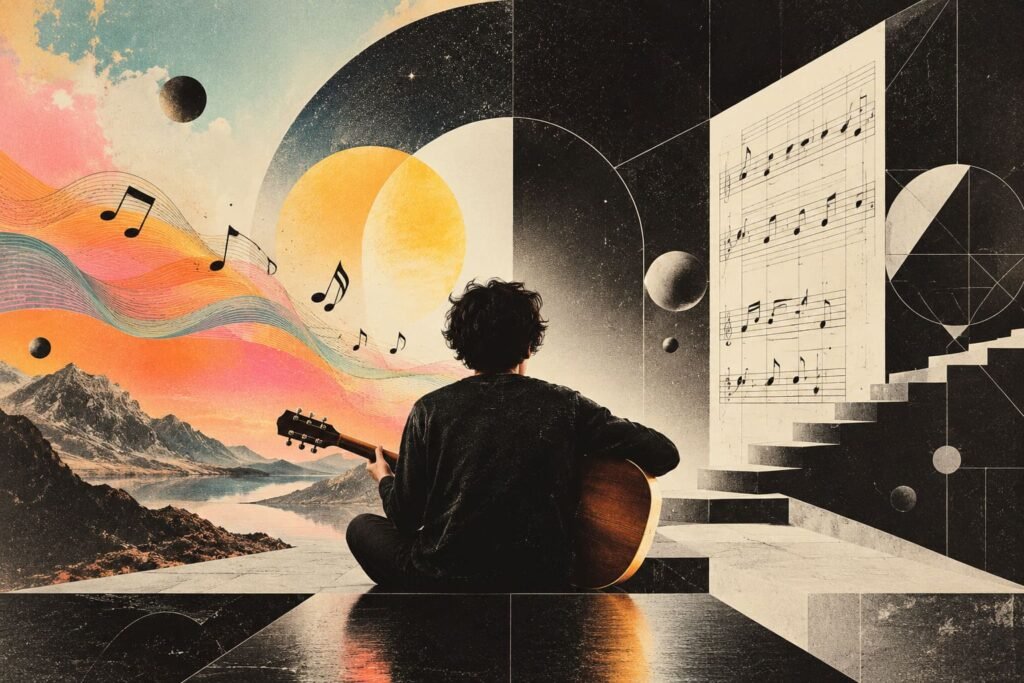
Is it possible to learn music without starting with theory?
Many people approach music with a small wound: they believe they don't have the right to play until they understand everything, or that a musical score is the only way to access sound. But the ear, the voice, the body, and imitation are already forms of musical knowledge.
Yes: you can start learning music without starting with theory. Listening, imitating, singing, moving, and playing an instrument are real gateways to learning. Theory is not an obstacle or an enemy: it comes later—or in parallel—to name, organize, and expand what we can already feel and do.
Music exists before it can be explained.
A child can recognize a song, respond to a beat, and sing a phrase before knowing what a scale is. Many traditions are passed down primarily through listening, repetition, observation, and collective practice. This doesn't mean they are less rigorous; it means their rigor resides first in gesture, sound, memory, and interaction with others.
Theory is a map. A map can be valuable and necessary, but it doesn't replace walking the territory. Someone who only memorizes chord names without hearing them hasn't yet developed a complete musical understanding; someone who plays by ear without any words for what they're doing may encounter limitations when communicating, analyzing, or expanding their musical vocabulary. The two approaches reinforce each other.
Four legitimate doors to get started
Hear
Choose a song, follow its rhythm, recognize when a section returns, and notice which instruments come in. The ear needs repeated experiences and attention.
Mock
Copying a phrase of speech, a clapping rhythm, or a fingering technique transforms something external into one's own action. Imitation is not a lack of originality: it's a school of attention to detail.
Embody
Walking pulses, marking accents, breathing a phrase and singing before playing connect duration, intention and body.
Play
Responding to a note, inventing endings, changing a rhythm, or exploring timbres sparks curiosity. The game is practice with permission to make mistakes.

Why is imitation a profound practice?
When we imitate, we don't just copy notes. We try to reproduce duration, intensity, articulation, timbre, breath, and gesture. In a recent study with people without musical training, alternating observation of a performer's hand with imitation facilitated the learning of a keyboard sequence compared to visual cues of keys alone. This doesn't make imitation the only solution, but it supports something that musicians from many traditions already know: seeing and hearing someone play provides information that an abstract explanation doesn't always deliver.
That's why a lively class can begin with a resonant question. "Can you answer this sentence?" opens up listening, coordination, and trust. Then the theory can come in to say: this was an interval, this was syncopation, this was a cadence. The name doesn't replace the experience; it makes it shareable.
| Moment | Practice | Theory can help to… |
|---|---|---|
| Hear | Distinguish repetition, contrast, pitch, and pulse in a song. | Naming form, meter, intervals, and functions when the ear already has a reference. |
| Mock | To reproduce a short phrase by voice or instrument. | Understanding fingerings, scales, or patterns without them appearing as isolated data. |
| Create | Vary a rhythm, complete a melody, respond to a chord. | To offer more options for harmony, development, and organization. |
| Reflect | Describe what worked, what it cost, and what it felt like. | Connect experience with language and plan the next practice. |
Theory fails to bring order from the outside.
When presented too early or as an exam, theory can make music seem like a permission system. But a good explanation has another effect: it shines a light. Suddenly we recognize that the color we like has a modal relationship, that the difficult rhythm can be subdivided, that the harmonic tension has ways to resolve or prolong.
The right time isn't the same for everyone. Some people enjoy understanding from the very first lesson; others need to play and sing before they want a terminology. Sensitive teaching doesn't choose between intuition and structure: it observes which tool opens the next step.
Practice to start today: Choose a simple song. Sing only its first melodic gesture. Find it on an instrument without looking at the sheet music. Then change its last note and listen to which ending convinces you. Afterward, if you want, figure out which notes you used. In that order, the theory emerges as a discovery.
What if I feel like I "have no hearing"?
Hearing is not a magical possession that some people receive and others don't. It's a practice of attention that can be developed. Every time you compare two notes, recognize a rhythm, tune a voice, imitate a phrase, or notice that something "didn't land" where you expected, you are exercising your auditory skills.
Progress is often less spectacular than we imagine: a melody that once seemed impossible can now be sung, a chord is recognizable by its timbre, a pulse is sustained unaided. These small transformations are the foundation of a lasting musical relationship.

Your entry into music can begin right where you are.
At Legatto, we integrate ear, body, technique, theory, and creation into a living process. Discover our classes, Discover the Legatto methodology or receives personalized support in a mentoring.
Frequently Asked Questions
Is it possible to learn music without knowing theory?
Yes. You can start with listening, imitation, singing, rhythm, and instrumental practice. Theory can be incorporated later or in parallel to organize and expand what you learn.
Is it bad to learn by ear?
No. Learning by ear develops attention, memory, and a direct connection with sound. Combining it with theory can give you more tools to communicate, analyze, and create.
Where do I begin if I've never studied music?
Choose an accessible song, tap out the beat, sing a short phrase, and try to find it on an instrument. Work in small fragments and repeat with curiosity.
When is it appropriate to study music theory?
When a practical question asks for a name or a tool—understanding a rhythm, expanding chords, reading a part, or communicating an idea—theory works best when connected to a sonic experience.
Sources and for further exploration
- Action Observation Training promotes the acquisition of new musical skills. Study on observation and imitation in keyboard learning.
- The Music Learner Voice. Review of the continuum between formal and informal learning in music education.
- Rhythm-Based and Pitch-Based Music Training. Examples of musical learning through perception, imitation, movement, and singing.
- Yuliia Tretynychenko / Unsplash and Kateryna Hliznitsova / Unsplash. Interior images licensed under Unsplash.
