
Blog

Julián Carrillo and the 13th Sound: listening between the notes
¿Qué hay entre dos notas del piano? Explora el Sonido 13 de Julián Carrillo con ejemplos auditivos, instrumentos reales y explicaciones claras de sus microintervalos.
see more
Learning music as an adult: yes, you can start from scratch
It's never too late to learn music. A clear and practical guide for adults who want to start playing, singing, listening, and creating from scratch.
see more
Musical Tension and Resolution: The Complete Guide
Music brings us to the edge and sometimes decides to bring us back home. A sensory and theoretical guide to harmonic, melodic, rhythmic, timbral, and formal tension, with all its forms of resolution.
see more
Why an out-of-tune note bothers us… and when it stops bothering us.
Is a pitch-out note a physical error or a learned expectation? We explore beats, temperaments, culture, and exercises to turn pitch-out into a creative compass.
see more
You know more about music than you think.
Music education has oscillated between two extremes: rigid methods that can stifle curiosity and unstructured learning that hinders profound progress. We explore what needs to change and how a freer, more rigorous, humane, and Latin American-focused music education could be built.
see more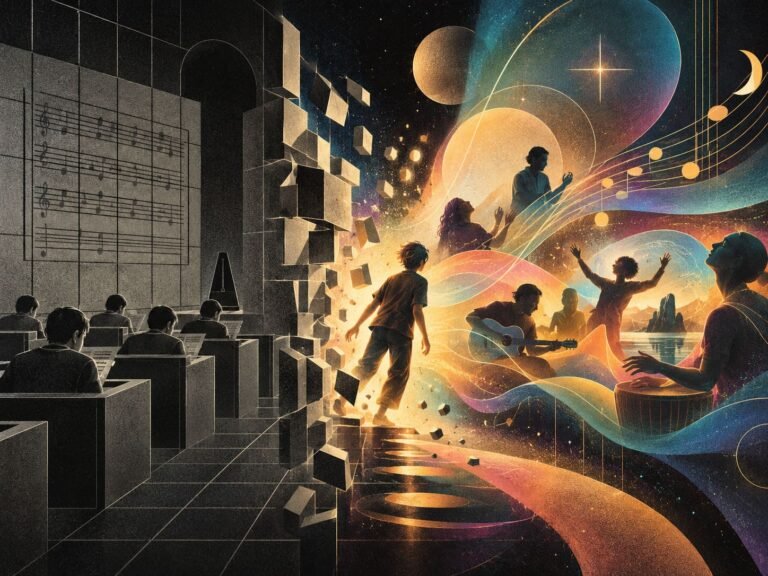
Music education needs to evolve.
Music education has oscillated between two extremes: rigid methods that can stifle curiosity and unstructured learning that hinders profound progress. We explore what needs to change and how a freer, more rigorous, humane, and Latin American-focused music education could be built.
see more
Music and grief: why we need songs to say goodbye
When words fall short, music steps in. We explore why songs accompany grief, trigger memories, and help us say goodbye to those we love.
see more
Music that is not written: oral tradition and collective memory
Some melodies seem to discover themselves as they unfold. We explore how repetition, contour, tension, memory, and expectation can make a note feel inevitable.
see more
What makes a melody feel inevitable?
Some melodies seem to discover themselves as they unfold. We explore how repetition, contour, tension, memory, and expectation can make a note feel inevitable.
see more
Circle Singing: what it is and how to create music with other voices
Voice · improvisation · collective listening. What is Circle Singing? Imagine someone singing a phrase of just three notes. Several people repeat it. Another voice joins in, playing a bass line. Someone adds rhythm with their mouth. Another person finds a harmony, and little by little, what was silence just seconds ago begins to transform…
see more