Comparative music theory reveals that the concept of scale is not merely a homogeneous mathematical abstraction, but a dynamic reflection of the aesthetic, cosmological, and liturgical philosophies of civilizations. While the post-Renaissance Western musical paradigm has prioritized the development of structures suitable for harmonic modulation and polyphonic architecture within a tempered space, other global traditions conceive of the tonal spectrum through complex networks of melodic behavior, note hierarchies, and microtonal expressiveness.
Traditions such as raga from India, the maqam of the Islamic world, the dastgah Persian or the oktōēchos The Byzantine liturgy demonstrates that a scale is not a static inventory of frequencies, but a living framework for improvisation, affection, and spiritual religious expression.
Epistemologies of tuning and temperament: from acoustic physics to modal aesthetics
The division of the octave varies according to the aesthetics of each culture. While the West prioritized free modulation, sacrificing the purity of the intervals, other traditions maintained just consonance or microtonality to emphasize the melody.
Equal Temperament (12-TET): Divide the octave into 12 equal semitones. It's a mathematical solution that makes changing keys easier, although it loses the acoustic purity of thirds.
Classical music of India: Divide the eighth into 22 shrutis (microtones). Its central structure, the raga, it is not just a scale; it defines principal notes (vadi and samvadi), upward and downward trajectories (arohana/avarohana) and key phrases (pakad).
Traditions of the Middle East and Persia:
Arabic Maqam and Turkish Makam: They use microtonal systems (24 quarter tones in Arabic and 53 commas in Turkish). They construct their modes by grouping cells of notes (ajnas) joined by points of articulation (ghammaz) and guided by a melodic path (seyir).
Iranian Dastgah: Macrostructure that organizes small melodic models (gushehs) transmitted orally through the traditional repertoire (radif).
For this study we will focus on the points of contact with the 12-note system, facilitating the identification of parallels from our auditory familiarity.
Pentatonic scales: structural universality and regional divergences
The five-note pentatonic scale is one of the oldest tonal frameworks known to humankind, documented on Paleolithic bone flutes found at sites such as Jiahu in China's Henan province, with an estimated age of 900 years. Musicology classifies these scales into two main types: anhemitonic scales, characterized by the absence of semitones and their consequent consonant fluidity, and hemitonic (or ditonic) scales, which contain semitones and leaps of a third that add tension and dramatic color.
The five-tone worldview in imperial China and the Wu Xing system
In ancient China, the pentatonic system was codified as a rigorous mathematical and cosmological structure. The tuned bronze bells (bianzhongThe Shang dynasty already reflected the systematic use of the five fundamental tones, which were associated in philosophical treatises such as the Yueji (Book of Music) and the Liji (Book of Rites) with the ordering of the State, individual morality and the functioning of the cosmos.
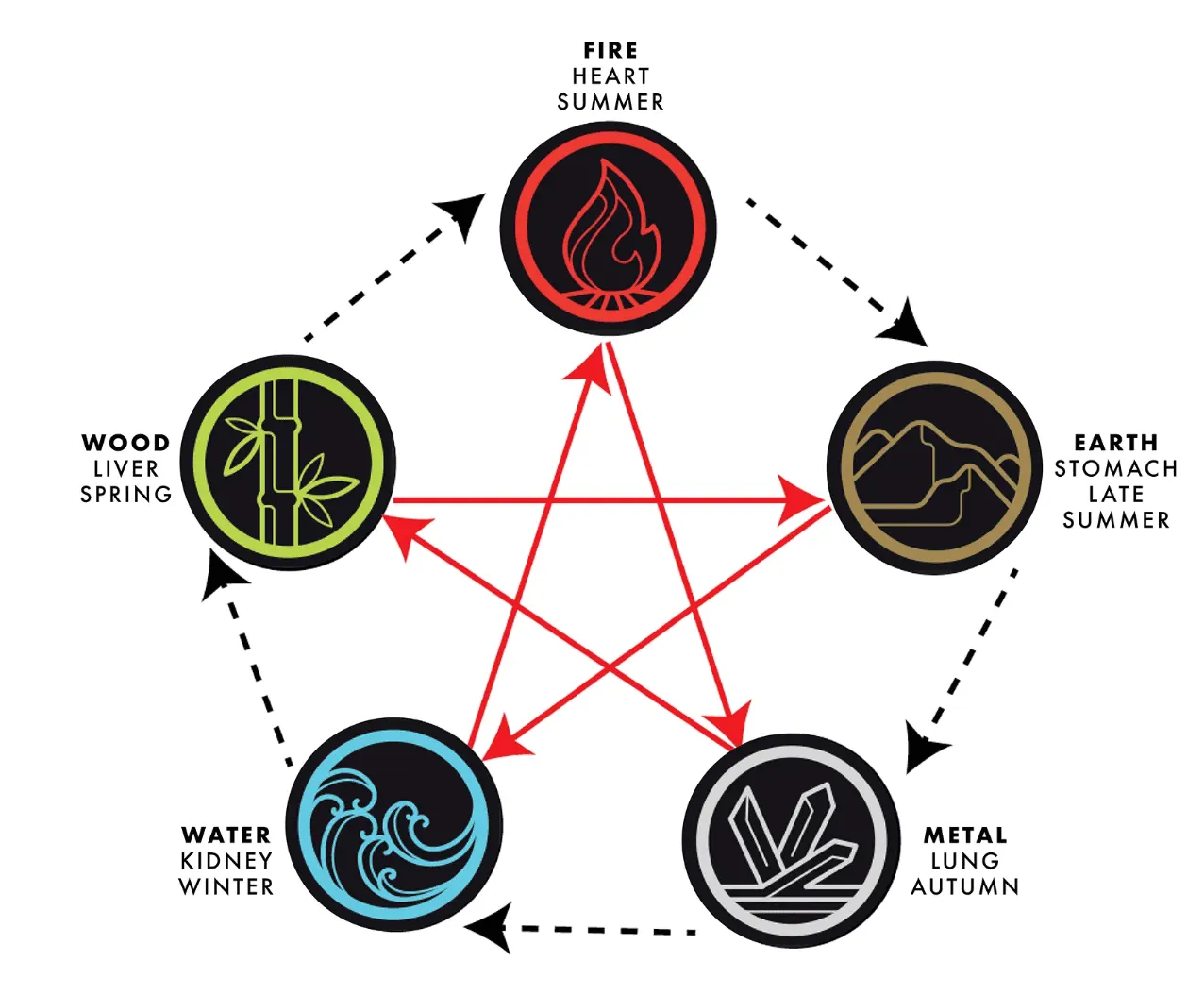
Through the theory of Wu Xing (the Five Elements), the Zhou dynasty integrated the five tones —called Gong (宫), Shang (商), Thu (角), Zhi (徵) and You (羽)— in an analog system that united music with traditional medicine and astronomy.
The classic medical treatise Huangdi Neijing He formalized the five-phase music therapy, associating each tone with a vital organ (zanga specific emotion, under the premise that the correct vibrations could regulate the flow of Qi or vital energy:
Gong (Western C): Corresponds to the Earth element, the spleen, the emotion of reflection, and represents the sovereign. It possesses a profound and stabilizing character, identifiable by the diagnostic interval of a major third between the tones. Gong and Thu19.
Shang (Western RE): Linked to Metal, the lungs, melancholy, and the ministerial class. Produces a bright, crystalline sound.
Thu (Western MI): Associated with Wood, the liver, anger, and the common people. It has a sharp, energetic tone that promotes vitality.
Zhi (Western Sun): It belongs to Fire, to the heart, to unbridled joy and to public affairs. Its tension evokes intensity and resolve.
You (Western LA): Connected to Water, the kidneys, fear, and the material forces of society. Its sound is fluid and transparent.
This ethical conception of music was vehemently defended by philosophers such as Confucius, who maintained that noble music purified the passions and promoted social harmony (Zhonghe), in contrast to the vulgar melodies that incited state disorder.
The Japanese pentatonic system and the innovations of Yatsuhashi Kengyo
Japanese musical theory developed a unique approach to hemitonic pentatonic scales, moving away from models imported from the Tang court of China. Although the ancient systems Ryo and Ritsu While preserving pentatonic cores within seven-tone structures, the secular music of the Edo era gave way to the exclusive use of five-note scales adapted to the koto (thirteen-stringed zither) and the shamisen (three-stringed lute).
The architect of this aesthetic revolution was Yatsuhashi Kengyo (1614–1685), a blind shamisen and koto player who adapted popular instrumental techniques to create a secular style accessible to the urban population, founding the genre of songs with instrumental accompaniment known as jiuta. Yatsuhashi modified the traditional tunings based on the Gagaku courtier to popularize the scale Hirajōshi (standard tuning), characterized by semitone intervals that evoke a deep melancholy and introspection, aesthetic qualities that defined Japanese instrumental music for koto solos as his celebrated work Rokudan no shirabe.
Likewise, the Japanese instrumental tradition consolidated the use of the scale In (either Miyako-bushi), widely used in popular songs such as the emblematic Sakura, Sakura. The scale is derived from this. Insen, adapted from the shamisen repertoire, and the scale Iwato, of a dark and mysterious nature, associated with Noh theater and Shinto mythology. In contrast to these scales of dark nuances, the scale I It lacks semitones, projecting a bright and festive character in rural folk songs (min'yō) played on the bamboo flute shakuhachi.
The following table systematizes the global pentatonic scales, providing their equivalences in various traditional systems and their intervallic formulas.
Correspondences of Pentatonic Scales and Modalities
Explore the structure and cultural equivalences of each scale.
Western Reference
Formula (Degrees)
Sequence of Intervals
Equivalents in India (Carnatic / Hindustani)
Traditional Names and Cultural Origin
Aesthetic Character and Historical Implication
Major Pentatonic
1 - 2 - 3 - 5 - 6
T - T - Ts - T - Ts
Mohanam (South) / Bhoopali (North)
Gong Mode (宫, China); Me Mode / Ryo (Japan); Mullaittīmpāṇi (old Tamil music)
Absolute consonance, cosmological balance associated with the Earth.
Minor with a bright major sixth; used in modern jazz for its suspended sound.
The Western major scale and its diatonic modes: multidisciplinary parallels
The seven-note diatonic major scale, the foundation of the Western tonal system, has its theoretical roots in the treatises of Hellenistic Greece. The ancient system of the harmoniai It was later reinterpreted by copyists and monks of the Middle Ages to structure the liturgical repertoire of Gregorian chant, laying the foundations of the system of ecclesiastical modes or Octoechos. In modern theory, diatonic modes are defined as rotations of the same scale over different tonal centers of gravity or endings, each characterized by a specific interval or "color note".
Expanding the analysis to other cultures reveals conceptual parallels of great structural rigor. In southern India, Carnatic classical music systematized these collections of pitches into the scheme of 72 Melakarts (mother scales of seven tones), designed by the scholar Venkatamakhin in his treatise Chaturdandi Prakasika of the 17th century. In this system, each melakarta is a seven-note scale that divides the octave linearly and symmetrically. The equivalences between Western diatonic modes and Carnatic melakartas show a precise mathematical correlation.
In the world of Islamic music from the Middle East and North Africa, the diatonic tempered major scale finds its functional equivalent in the Maqam Ajam, characterized by its direct, bright and optimistic nature, free from the quarter-tone tunings common in the region.
Likewise, the Eastern Orthodox Church of Byzantine tradition developed a sophisticated eight-tone modal system called Byzantine Octoechos, which organizes melodies through particular melodic formulas, characteristic cadences, and the fundamental use of ison (a chorus that maintains a pedal or continuous sound of the tonic of the mode). Unlike in the West, Byzantine musical theory does not divide music into major and minor scales, but groups compositions into four genres of scales called diatonic, enharmonic, soft chromatic and hard chromatic, where the intervals have fluid microtonal tunings determined orally and traditionally.
The following comparative table traces the structural connections between the modes of the Western major scale and their equivalents in various traditional systems of the world.
Correspondences of Western Diatonic Modes
Interval structure and characteristic notes of each mode in different cultures.
Western Diatonic Mode
Degree Formula
Feature Color Note
Carnatic equivalent (South India)
Hindustani equivalent (North India)
Arabic/Turkish equivalent Maqam
Byzantine Correspondent
Ionian (Major Scale)
1 - 2 - 3 - 4 - 5 - 6 - 7
Fourth Round (4)
Dheerasankarabharanam (Melakarta 29)
Bilawal Thaat
Maqam Ajam
Echoes Triton (Enharmonic tone, tonic in F)
Doric
1 - 2 - ♭3 - 4 - 5 - 6 - ♭7
Sixth Major (6)
Kharaharapriya (Melakarta 22)
Kafi Thaat
Maqam Bayati / Husayni (with a fluctuation of a flat 3rd)
Echoes Protos (First Diatonic Tone, tonic in D)
Phrygian
1 - ♭2 - ♭3 - 4 - 5 - ♭6 - ♭7
Minor Second (♭2)
Hanumatodi (Melakarta 8)
Bhairavi Thaat
Maqam Kurd
Echoes Devteros (Second Soft Chromatic Tone)
Comparative Table of Diatonic Modes and World Traditions
Western Diatonic Mode
Degree Formula
Feature Color Note
Carnatic equivalent (South India)
Hindustani equivalent (North India)
Arabic/Turkish equivalent Maqam
Byzantine Correspondent
Ionian (Major Scale)
1 - 2 - 3 - 4 - 5 - 6 - 7
Fourth Round (4)
Dheerasankarabharanam (Melakarta 29)
Bilawal Thaat
Maqam Ajam
Echoes Triton (Enharmonic tone, tonic in F)
Doric
1 - 2 - ♭3 - 4 - 5 - 6 - ♭7
Sixth Major (6)
Kharaharapriya (Melakarta 22)
Kafi Thaat
Maqam Bayati / Husayni (with a fluctuation of a flat 3rd)
Echoes Protos (First Diatonic Tone, tonic in D)
Phrygian
1 - ♭2 - ♭3 - 4 - 5 - ♭6 - ♭7
Minor Second (♭2)
Hanumatodi (Melakarta 8)
Bhairavi Thaat
Maqam Kurd
Echoes Devteros (Second Soft Chromatic Tone)
Lydius
1 - 2 - 3 - 4 - 5 - 6 - 7
Augmented Fourth (♯4)
Kalyani (Melakarta 65)
Kalyan Thaat
It does not have a direct main maqam
Not representative in a purely representative form
Mixolydian
1 - 2 - 3 - 4 - 5 - 6 - ♭7
Minor Seventh (♭7)
Harikamboji (Melakarta 28)
Khamaj Thaat
Maqam Jiharkah (variant)
Echoes Tetartos (Fourth Diatonic Tone, tonic in G)
Aeolian (Natural Minor)
1 - 2 - ♭3 - 4 - 5 - ♭6 - ♭7
Minor Sixth (♭6)
Natabhairavi (Melakarta 20)
Asavari Thaat
Maqam Nahawand
First Tone Plagal Echoes (Protos Plagiarism, tonic in A)
Locrian
1 - ♭2 - ♭3 - 4 - ♭5 - ♭6 - ♭7
Diminished Fifth (♭5)
It does not possess, by excluding the just fifth (Panchama)
Meladalan
Maqam Lami (mathematical equivalence)
Echos Plagal of the Fourth Tone (liturgical variations)
The melodic minor scale and its modes in contemporary and traditional practice
The classical melodic minor scale arose from an aesthetic need for voice leading within European polyphony. When ascending melodically to the tonic, a leading tone (major seventh) was required to ensure a powerful harmonic cadence. However, maintaining the scale with a minor sixth created an awkward augmented second melodic interval between the flat sixth and the natural seventh. To avoid this three-semitone leap, classical theory decided to also raise the sixth to a major sixth during the ascent, descending under the diatonic pattern of the natural minor scale to alleviate chromatic tension.
In the practice of contemporary jazz and 20th-century popular music, improvisers discarded this ascending and descending duality and adopted the melodic minor in both directions symmetrically and invariably, commonly referred to as Jazz Minor. From the modal analysis of the melodic minor, seven jazz modes are derived that are essential for improvisation on altered chords, dominants, and augmented fourths.
The following table details the structure and modes of the invariant melodic minor scale (Jazz Minor).
Correspondences of the Melodic Minor Scale and its Modes
Interval structure and harmonic applications of scales according to different cultures.
Mode
Common Name in Jazz
Interval Formula (Degrees)
Sequence of Intervals
Carnatic/Hindostanian Equivalent
Harmonic Utility in Improvisation
First Mode
Melodic Minor (Jazz Minor)
1 - 2 - ♭3 - 4 - 5 - 6 - 7
T - s - T - T - T - T - s
Gourimanohari (Melakarta 23) / Raga Patdeep
Over minor chords with a major seventh.
Second Mode
Dorian ♭2 (Phrygian ♯6)
1 - ♭2 - ♭3 - 4 - 5 - 6 - ♭7
s - T - T - T - T - s - T
Raga Ahiri / Prabhateshwari
Over chords of a suspended flat ninth.
Third Mode
Lydium Augmented
1 - 2 - 3 - #4 - #5 - 6 - 7
T - T - T - T - s - T - s
—
Over major chords with augmented fifths.
Comparative Table of Melodic Minor Modes
Mode
Common Name in Jazz
Interval Formula (Degrees)
Sequence of Intervals
Carnatic/Hindostanian Equivalent
Harmonic Utility in Improvisation
First Mode
Melodic Minor (Jazz Minor)
1 - 2 - ♭3 - 4 - 5 - 6 - 7
T - s - T - T - T - T - s
Gourimanohari (Melakarta 23) / Raga Patdeep
Over minor chords with a major seventh.
Second Mode
Dorian ♭2 (Phrygian ♯6)
1 - ♭2 - ♭3 - 4 - 5 - 6 - ♭7
s - T - T - T - T - s - T
Raga Ahiri / Prabhateshwari
Over chords of a suspended flat ninth.
Third Mode
Lydium Augmented
1 - 2 - 3 - #4 - #5 - 6 - 7
T - T - T - T - s - T - s
—
Over major chords with augmented fifths.
Fourth Mode
Lydian Dominant (Overtone)
1 - 2 - 3 - ♯4 - 5 - 6 - ♭7
T - T - T - s - T - s - T
Vachaspati (Melakarta 64)
Over dominant chords with augmented fourth.
Fifth Mode
Mixolydian ♭6 (Hindu scale)
1 - 2 - 3 - 4 - 5 - ♭6 - ♭7
T - T - s - T - s - T - T
Charukeshi (Melakarta 26)
Over dominant chords with a suspended flat ninth.
Sixth Mode
Natural Locrian 2 (Aeolian ♭5)
1 - 2 - ♭3 - 4 - ♭5 - ♭6 - ♭7
T - s - T - s - T - T - T
—
Over half-diminished chords with a suspended ninth.
Seventh Mode
Altered Scale (Superlocrian)
1 - ♭2 - ♭3 - ♭4 - ♭5 - ♭6 - ♭7
s - T - s - T - T - T - T
Raga Faridi Todi
Over completely altered dominant chords.
When exploring the music of other regions, exact intervallic confluences are observed. The first degree of the melodic minor is absolutely assimilated to the 23rd melakarta of the Carnatic tradition., Gourimanohari, and to the raga Patdeep from northern India. The fourth mode, Lydian Dominant or Mixolydian #4, corresponds to the raga Vachaspati, highly valued in the Indian subcontinent for its mystical luminosity.
On the other hand, the fifth mode of the melodic minor, known as Mixolydian b6, is identified with melakarta number 26, Charukeshi. In the musical tradition of India, Charukeshi It is a scale of great emotional depth, associated with profound devotion (bhakti rasa) and to the poetic love plea (sringara rasa), demonstrating how a set of notes that in Western jazz functions as a rational tool for improvising over altered dominant chords, in South Asia acts as a direct mystical channel to the soul.
The harmonic minor scale and its modes: mysticism, lament, and liturgy
The harmonic minor scale is characterized by an augmented second between its sixth and seventh degrees (b6 and 7), an interval of a tone and a half that gives it a distinctive sound of great emotional drama. Although in Western classical and romantic harmony it was conceived to ensure the presence of the leading tone and the dominant chord in the minor mode, globally it is the origin of some of the most influential melodic systems in history.
The following table details the modes of the harmonic minor scale and their names in various cultures around the world.
Correspondences of the Harmonic Minor Scale and its Modes
Interval structure and traditional names in various cultures.
The fifth mode: the universality of the Dominant Phrygian
The fifth mode of the harmonic minor, known as Phrygian Dominant (formula 1 - b2 - 3 - 4 - 5 - b6 - b7), constitutes one of the greatest cultural crossroads in global music.
In the Jewish tradition of Eastern Europe and in music Klezmer —a genre of celebration and lament originally performed at Jewish weddings— is known as the mode Freygish or Ahava Rabbah (which translates from Hebrew as "Abundant Love," the name of a synagogue liturgical prayer). In klezmer music, Freygish It is the ideal framework for improvisation, characterized by a flexible behavior where the sixth degree can rise if the melodic line approaches from above, and the seventh degree can ascend to intensify the tonal rest.
Similarly, this mode constitutes the essence of Maqam Hijaz in the Arab, Turkish, and Persian world. The term refers to the geographical region of Hejaz, in present-day Saudi Arabia. This maqam evokes feelings of profound solitude, spiritual yearning, and mystical introspection, being the most widely used traditional vehicle for the recitation of Arabic poetry and melismatic singing. Through the Islamic domination of the Iberian Peninsula during Al-Andalus, these sounds permeated southern Spain, directly influencing the birth of flamenco singing and in the cadences of the various flamenco styles. In India, this mode is assimilated to the raga. Basant Mukhari in the north, and to Melakarta number 14, Vakulabharanam, in the south.
The fourth mode: the intersection of the Doric #4
The fourth mode of the harmonic minor, called Dorian with augmented fourth (1 - 2 - b3 - #4 - 5 - 6 - b7), shares an identical transcultural relevance. In Jewish instrumental music and synagogue liturgy, it is known as My Sheberach ("He who blessed," for the prayers recited before the Torah) or Ov Horachamim ("Father of Mercy"). This is the way in which the Doinas, improvised instrumental laments that simulate human sobbing, born from border contact between Jewish and Romanian musicians in the Carpathians.
In Near Eastern modal systems, this fourth mode is identified as the Maqam Nikriz or Nigriz, A pillar of classical instrumental compositions, it was used to project solemnity and reverent awe before the deity. In the Balkan Peninsula, Greek musicians assimilated this sound into the urban musical genre. Rebetiko under the name of Souzinak or Peiraiotiko Minore (smaller than Piraeus). In southern India, it corresponds to Melakhart number 58, Hemavati, raga that evokes feelings of heroic resolve and passionate devotion.
The double harmonica system: from courtly mysticism to symphonic rock
The double harmonic major scale (1 - b2 - 3 - 4 - 5 - b6 - 7The harmonic minor scale is distinguished from the common harmonic minor by having two augmented second intervals, symmetrically located at both ends of the scale. This gives it a perfect palindromic structure that reads the same in ascending and descending directions (semitone step formula: 1 - 3 - 1 - 2 - 1 - 3 - 1).
Correspondences of the Double Harmonic Major Scale and its Modes
Symmetrical structure, formulas and correspondences in world music.
Double Minor Harmonica, Lesser Hungarian, Gypsy Minor
1 - 2 - ♭3 - ♯4 - 5 - ♭6 - 7
T - s - T+s - s - s - T+s - s
Simhendramadhyamam (Melakarta 57)
Maqam Khurshidi (Kurdish Music); Prayer Ahava Rabbah and Hava Nagila
Fifth Mode
Eastern, Mixolydian ♭5 ♭9
1 - ♭2 - 3 - 4 - ♭5 - 6 - ♭7
s - T+s - s - s - T+s - s - T
Kamavardhani / Pantuvarali (variant)
Maqam Hijaz Gharib / Oriental Mode
Sixth Mode
Augmented Ionian ♯2 (Ionian ♯2 ♯5)
1 - #2 - 3 - 4 - #5 - 6 - 7
T+s - s - s - T+s - s - T - s
—
—
Seventh Mode
Locrio ♭♭3 ♭♭7 (Ultra Locrio)
1 - ♭2 - ♭♭3 - 4 - ♭5 - ♭6 - ♭♭7
s - s - T+s - s - T - s - T+s
—
—
This set of notes corresponds to melakarta number 15, Mayamalavagowla, In the Carnatic tradition of South India, this is the first obligatory scale taught to children due to its perfect symmetry and stability of intervals. In North India, it is the basis of the Bhairav Thaat and of the raga Bhairav, Mythologically associated with the god Shiva, it is performed in the early hours of dawn to suggest the awakening of the cosmos and the dissipation of the morning mist. In the Middle East, it corresponds to the Maqam Hijaz Kar, a symbol of the highest ornamental wealth, and in Europe it is traditionally known as the Byzantine scale or major Gypsy scale75.
The fourth mode derived from this double harmonic structure is the scale Double Minor Harmonica (either Hungarian/Gypsy Minor, formula 1 - 2 - b3 - #4 - 5 - b6 -7), equivalent to melakarta number 57, Simhendramadhyamam8. In European classical music, Franz Liszt used this scale as the harmonic basis of his famous Hungarian Rhapsody No. 2 to evoke the folklore of Central European Roma communities. In Kurdish music, this scale is called maqam. Khurshidi. Master Hassan Zirak played a fundamental role in codifying this maqam, which omits quarter tones in the Kurdish folk tradition, inspiring Western rock guitarists to create highly virtuosic, neo-neoclassical solos. In Jewish mystical tradition, it is the base scale of the emblematic prayer. Ahava Rabbah and of festive singing Hava Nagila.
A system of scales, habitual melodic phrases, modulation possibilities, ornamentation norms, and conventions aesthetics - Arabic Maqam World, https://www.maqamworld.com/en/maqam.php