
Ervin Wilson's Musical Theory: Geometry, Sound, and Recursion
Ervin M. Wilson (1928–2016) represents one of the most formidable and innovative figures in the history of music theory, physical acoustics, and microtonality. While traditional Western music theory has tended to treat tuning systems as static structures derived from historical practice, Wilson's work approached tuning from an integrated mathematical perspective, combining discrete number theory, multidimensional geometry, combinatorics, and physiological psychoacoustics.

Introduction and Acoustic Fundamentals: The Tempered System Problem
To understand the significance of the systems created by Wilson and the psychoacoustic reason why they are perceived as qualitatively "more in tune" than standard scales, it is necessary to first analyze the structure of 12-Tone Equal Temperament (12-TET). The 12-TET system subdivides the octave interval—whose physical frequency ratio in fundamental acoustics is 2:1—into twelve logarithmically identical parts. The frequency ratio between any pair of adjacent semitones is given by the irrational value (2^(1/12) ≈ 1.059463), which assigns exactly 100 Cents to each semitone within the 1200 Cents spectrum that makes up the octave.
The functional advantage of the 12-TET lies in its absolute symmetry, which grants unlimited freedom of transposition across the twelve keys without altering the proportions of the intervals. However, this symmetry requires a significant acoustic sacrifice: a systematic deviation from Just Intonation, that is, from the simple whole-number ratios that govern the series of natural harmonics.
In Just Intonation, the frequencies of the intervals form simple whole-number ratios (2:1 for the octave, 3:2 for the perfect fifth, 5:4 for the major third, and 7:6 for the harmonic seventh). When two tones forming a pure whole-number ratio are played simultaneously, their sound pressure waves align periodically without generating annoying beats or phase interference. In contrast, the intervals of the 12-TET force irrational ratios that distort these harmonic alignments.
Table of Harmonic Intervals
Detailed comparison between the Just Tuning (Natural Harmonic Series) and the 12-Tone Equal Temperament (12-TET).
| Harmonic Interval | Just Reason | Fair Value | 12-TET | Deviation (12-TET) | Psychoacoustic Impact |
|---|---|---|---|---|---|
|
Octave
|
2:1 | 1200.00 Cents | 1200.00 Cents |
0.00 Cents
|
Pure, perfect periodic alignment. |
|
Fifth Fair
|
3:2 | 702.96 Cents | 700.00 Cents |
-2.96 Cents
|
Virtually pure, almost imperceptible blending. |
|
Fourth Match
|
4:3 | 498.05 Cents | 500.00 Cents |
+1.95 Cents
|
Minimum deviation. |
|
Third Major
|
5:4 | 386.31 Cents | 400.00 Cents |
+13.69 Cents
|
Severely sharp; rapid beating that produces roughness. |
|
Third Minor
|
6:5 | 315.64 Cents | 300.00 Cents |
-15.64 Cents
|
Notable serious deviation; harmonic opacity. |
|
Seventh Harmonic
|
7:4 | 968.83 Cents | 1000.00 Cents |
+31.17 Cents
|
Extremely out of tune; it loses its consonant quality. |
As the analysis of the major third (5:4) demonstrates, the 12-TET version exceeds the natural harmonic ratio by more than 13.6 cents. This difference results in a periodic amplitude fluctuation (beating) that the human ear perceives as unresolved tension. Erv Wilson dedicated his life to developing theoretical frameworks capable of overcoming this compromise, not by returning to rigid historical scales, but by creating tuning systems that preserve acoustic consonance and melodic coherence through geometric and algebraic principles.
Moments of Symmetry (MOS): The Geometry of Melodic Generation
The concept of Moments of Symmetry (Moments of Symmetry, The MOS scale (or microtonal scale), proposed by Erv Wilson in the 1960s and formalized in his 1975 writings, constitutes one of the fundamental pillars of modern microtonal theory. A MOS scale is defined as a periodic scale generated by the iterative superposition of a constant interval, called the comma. generator (g), reduced within a period of repetition or equivalence interval (p), which usually corresponds to the eighth (2:1).

The Linear Generation Mechanism
The generating process of a MOS operates analogously to the traditional cycle of fifths, but abstracted to any real interval. Starting from a fundamental tone, the generating interval is successively added. g. Each time the accumulated value exceeds the period limit p, the value of is subtracted p to relocate the note within the range of a single octave.
A set of notes generated using this procedure formally becomes a Moment of Symmetry only at those points in the chain where the distance between all adjacent scalar notes results in only two step sizes: a large interval (L, Large) and a small interval (s, Small).
For a scale to possess the condition of a strict MOS, it must satisfy the following formal requirements of Wilson's theory:
- Strict Binary StepAll contiguous degrees of the scale are separated by intervals of magnitude. L or s, without there being a third intermediate size.
- Coprima ConditionThe total number of large steps (a) and small steps (b) that make up the scale are coprime integers, satisfying that gcd(a,b) = 1.
- Bifocality PropertyAny interval formed by the combination of a fixed number of scalar steps (such as jumps of two, three, or four degrees) will present, throughout the entire extent of the scale, a maximum of two possible sizes.
- Closure by Disjunction: When the MOS cycle is completed, the final interval that connects the last note to the origin functions as a disjunct element that maintains the melodic integrity of the scale.
A prime example of the MOS scale is the diatonic scale of Western music. Generated by accumulating 6 pure fifths (3/2) reduced to the octave, the diatonic scale consists of 7 notes distributed in 5 large steps (whole tones) and 2 small steps (semitones), formally represented by the signature 5L 2s. Similarly, if the generative process is interrupted after 4 fifths, the 5-note pentatonic MOS with signature is obtained 2L 3s.
MOS (Moment of Symmetry) Scales
Structural analysis according to the theory of Erv Wilson: large step patterns (L) and small (s), cyclic generators and sound character.
| MOS Scale Name | Signature of Steps | Grades | Typical Generator (g) | Period (p) | Sound Character |
|---|---|---|---|---|---|
| Pentatonic Diatonic | 2L + 3s | 5 | Fifth Fair (3/2) | Eighth (2/1) | Absence of adjacent semitones; fluid and open consonance. |
| Traditional Diatonic | 5L + 2s | 7 | Fifth Fair (3/2) | Eighth (2/1) | Basic structure of the Western modal and harmonic system. |
| Sub-Diatonic of 17-EDO | 3L + 4s | 7 | 5 steps of 17-EDO | Eighth (2/1) | Microtonal heptatonic scale of neutral and symmetrical sound. |
| Decanton of 17-EDO | 7L + 3s | 10 | 5 steps of 17-EDO | Eighth (2/1) | Microtonal system of high melodic density and continuity. |
| Neutral of 13-EDO | 2L + 5s | 7 | 6 steps of 13-EDO | Eighth (2/1) | Scale characterized by non-Pythagorean neutral thirds and sixths. |
| Bohlen-Pierce MOS | 4L + 5s | 9 | BP Generator | Tritone (3/1) | Microtonal system with a twelfth equivalence interval. |
The Explanation of Tuning Superiority in MOS
The reason a MOS scale is perceived as significantly "more finely tuned" than a conventional 12-TET scale lies in the variability of the generator. In the 12-TET, the generator is rigidly confined to 700 cents. In contrast, in a MOS scale, the generator g It can take the value of a pure harmonic ratio (such as 3/2, 5/4, or 7/4) or of a high-precision linear temperament (such as 31-EDO or 53-EDO)2.
The acoustic behavior of the scale is characterized by the Rate of Pass Spectrum (R = L/s):
- Ratio close to unity (L ≈ s)The scalar intervals approximate a uniform division, producing an extremely smooth, integrated sound texture free of sharp melodic edges.
- High ratio (L >> s)The disparity between the steps L and s It establishes a marked melodic hierarchy, accentuating the modal polarity and the dramatic tension between neighboring degrees.
Constant Structures: The Multiboundary Harmonic Generalization
While Moments of Symmetry guarantee exceptional melodic coherence through the use of a single linear generator, Wilson recognized that musical scales oriented toward pure harmony must accommodate multiple prime harmonic factors (multi-boundary systems based on harmonic series ratios such as 3, 5, 7, 11, and 13). In such systems, the scale can feature more than two adjacent step sizes. To classify and design these complex structures without losing tonal coherence, Erv Wilson developed the concept of Constant Structure (Constant Structure).
A scale is defined as a Constant Structure if Each occurrence of a given frequency ratio or harmonic interval invariably encompasses the same exact number of steps or scalar degrees, regardless of the note from which it is measured..
In a scale lacking the property of constant structure, a purely harmonic interval like the perfect fifth (3:2) could span 7 scalar steps in one section of the keyboard and 6 or 8 steps in another, confusing tonal perception and generating functional ambiguity. Conversely, in a Wilson Constant Structure, if the 3:2 interval spans k scalar degrees, all The 3:2 consonances present in any region of the scale will encompass exactly k scalar degrees.
Every MOS scale is, by construction, a Constant Structure of a single generator. The theory of Constant Structures extends this principle to microtonal scales composed of diverse harmonics, ensuring that intervallic complexity does not degenerate into acoustic disorder.

The Scale Tree, Continued Fractions, and Noble Generators
To systematize all possible Moments of Symmetry within a unified mathematical order, Erv Wilson designed in 1994 the structure known as The Tree of Scales (The Scale Tree). From the point of view of pure mathematics, Wilson's Scale Tree is equivalent to the construction known in number theory as the Stern-Brocot Tree or the Farey sequence.
The Operation of Through and Scalar Recursion
The Scale Tree is generated recursively from two limiting numerical nodes that represent the extremes of the tuning space: the fraction 0/1 (corresponding to the origin or zero step) and the fraction 1/1 (corresponding to the entire period). Starting from two adjacent nodes a/b and CD, The tree calculates a child node using the operation by means of:
| Through | ( |
|
, |
|
) | = |
|
In the acoustic-musical interpretation developed by Wilson:
- He denominator (b + d) indicates the total number of notes that make up the new MOS scale.
- He numerator (a + c) represents the number of scalar steps spanned by the generating interval on that scale.

MOS Generator Tree
Mathematical relationship between continued fractions of Generator Tree, the number of notes in the scale and the derived microtonal temperaments.
| Tree Branch | Number of Notes (b+d) | Generator Steps (a+c) | Resulting Scale and Temperament Context |
|---|---|---|---|
| 1 / 2 | 2 | Step 1 | Primary symmetric division (Tritone or half octave). |
| 1 / 3 | 3 | Step 1 | Elementary triadic scale. |
| 2 / 5 | 5 | 2 steps | Pentatonic MOS derived from the fifth. |
| 3 / 7 | 7 | 3 steps | Traditional Diatonic MOS. |
| 5 / 12 | 12 | 5 steps | Chromatic structure equivalent to the 12-TET. |
| 8 / 19 | 19 | 8 steps | 19-tone system (19-EDO); remarkable accuracy in minor thirds. |
| 13 / 31 | 31 | 13 steps | 31-tone system (31-EDO); excellent approximation to Just Intonation of limit 5. |
Continued Fractions and the Golden Generator
By descending the Scale Tree, systematically alternating between left and right choices, the resulting scale proportions correspond to the convergent continued fractions of irrational numbers. The path of maximum alternation in the tree converges towards the Noble Number par excellence: the Golden Ratio (φ ≈ 1.618):
| φ | = |
|
≈ | 1.61803398875 |
When a MOS scale uses a generator derived from the golden ratio (approximately 833.09 Cents), the number of notes in successive scales exactly follows the Fibonacci sequence (1, 2, 3, 5, 8, 13, 21, 34, 55…).
These structures, called MOS Nobles, They possess the property of being infinitely recursive. Unlike rational generators that end up closing in repetitive cycles, a golden generator continuously adds new notes that subdivide existing intervals in constant golden ratios, guaranteeing an infinitely rich and never periodic melodic density.
Mount Meru, Recurrent Sequences and Self-Reinforcing Proportional Triads
A fundamental milestone in Wilson's thinking was the exploration of the ancient Indian combinatorial matrix known as Meru Prastara (or Mount Meru), known in the West as Pascal's Triangle. Wilson discovered that by drawing diagonals at specific angles through Mount Meru, families of recurring numerical sequences with unique acoustic properties were obtained.
The Mount Meru Sequences
While the traditional Fibonacci sequence (associated by Wilson with the Meru #1 level) is calculated by adding the two immediately preceding terms (Hn = Hn−1 + Hn−2), Wilson investigated sequences generated by higher-order initial conditions ("seeds"):
| Meru #2 sequence: | Hn | = | Hn−3 + Hn−1 | with initial seed (1, 1, 1) |
This difference equation yields the entire series:
1, 1, 1, 2, 3, 4, 6, 9, 13, 19, 28, 41, 60, ....
Proportional Triads and Tones of Difference
The crucial discovery by Wilson and his collaborator Kraig Grady lies in the harmonic behavior of these sequences. By taking three consecutive terms that satisfy the additive relationship of the sequence and raising the resulting frequencies to the same octave by doubling the values, they obtain proportional triads (also called equally beaten).
Considering as an illustration a relationship of the sequence Meru #3, where it is true that 16 + 21 = 37:
- The two lower terms are doubled to transpose them to the upper octave: 16 x 2 +32 and 21 x 2 +42.
- The term sum is positioned (37) in the center, forming the triad of frequencies: 32 : 37 : 42.
- The distance between adjacent components of the triad is constant: 37 - 32 = 5 and 42 - 37 = 5.

The Psychoacoustic Self-Reinforcement Mechanism
When two pure tones of frequencies f1 and f2 When they interact in the human auditory system at sufficient volumes, the nonlinear response of the cochlea generates a combination tone called tone of difference:
| fdifference | = | | | f2 − f1 | | |
For the proportional triad 32 : 37 : 42, The difference tones produced between pairs of adjacent notes are: 37 − 32 = 5 and 42 − 37 = 5
The value 5 obtained is not an arbitrary number; it is precisely a term that appeared early in the same numerical sequence as Mount Meru.
This phenomenon demonstrates that the scales built on the sequences of Mount Meru form self-reinforcing acoustic systems. The auditory distortion products (difference tones) generated by playing the chords do not produce extraneous frequencies or unwanted dissonances; instead, they fall precisely on notes that already belong to the scale or its generating seed. The scale psychoacoustically reinforces itself during musical performance.
Multidimensional Geometry: Combinatorial Product Sets (CPS)
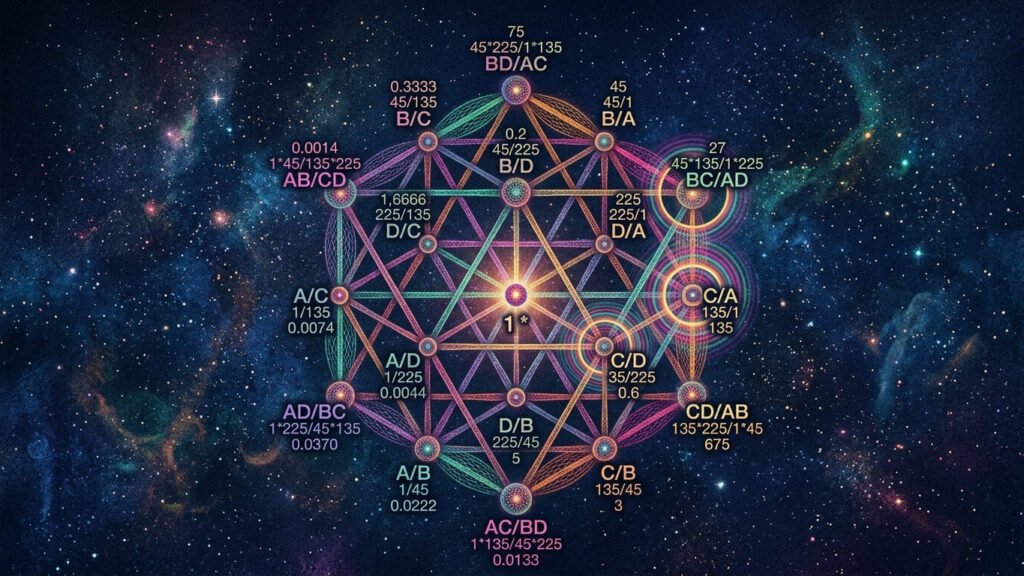
Transcending the one-dimensional linear construction based on chains of generators, Erv Wilson pioneered the conceptualization of musical scales representable as lattices or polygons within multidimensional geometric spaces. This aspect of his work is synthesized in the Combinatorial Product Sets (Combination-Product Sets, or CPS)1.
Combinatorial Formulation of the CPS
A CPS set is generated by selecting a number n of harmonic factors or base prime numbers (for example, the set of harmonics 1, 3, 5, 7, 9, 11) and calculating the products of all possible combinations taken from k in k elements. The number of tones that make up the resulting scale strictly corresponds to the binomial coefficient:
| CPS Notes | = | ( |
|
) | = |
|
Erv Wilson's CPS Structures
Geometric arrangement of harmonics according to the binomial formula (n, k), linking the number of notes with polyhedral and hyperspatial projections.
| CPS Structure | Binomial Parameters | Number of Notes | Associated Spatial Geometry | Harmonic and Intervallic Property |
|---|---|---|---|---|
| Hexania | (4, 2) | 6 | Octahedron (3D) | It contains 4 harmonic triads and 4 subharmonic triads in perfect symmetry. |
| Dekanía | (5, 2) | 10 | Tetrahedral Projection (4D) | 10-tone structure with specular self-inversion. |
| Eikosanía | (6, 3) | 20 | Polyhedral Icosahedron | Matrix rich in 20 intertwined notes of limit 11. |
| Hebdomad | (7, 3) | 35 | Hyperspatial Complex (5D) | Expansive network for advanced microtonal modulations. |
Hexania as a Geometric Model
The Hexania ((4, 2) = 6 grades) This clearly illustrates the structural beauty of CPS. By choosing 4 prime factors (for example, 1, 3, 5, 7), the 6 notes of the scale are obtained by multiplying them in pairs: (1 x 3 = 3), (1 x 5 = 5), (1 x 7 = 7), (3 x 5 = 15), (3 x 7 = 21), and (5 x 7 = 35).
In three-dimensional space, these six frequencies occupy the six vertices of a regular octahedron. The octahedron's symmetry ensures that the six notes are grouped with absolute fairness into four harmonic triads (pure major chord structures) and four subharmonic triads (pure minor chord structures) that share common edges, offering an intuitive three-dimensional map for harmonic navigation and modulation.

Instrumental Mapping and Isomorphism in Generalized Keyboards
A recurring historical problem in microtonal music is the incompatibility between new tuning systems and existing performance interfaces. The conventional piano keyboard, designed under the strict logic of the 12-TET (7 white keys + 5 black keys), imposes a physical barrier when trying to interpret scales of 17, 19, 31 or 53 tones, as well as complex geometric structures such as Hexanias or Eikosanias.
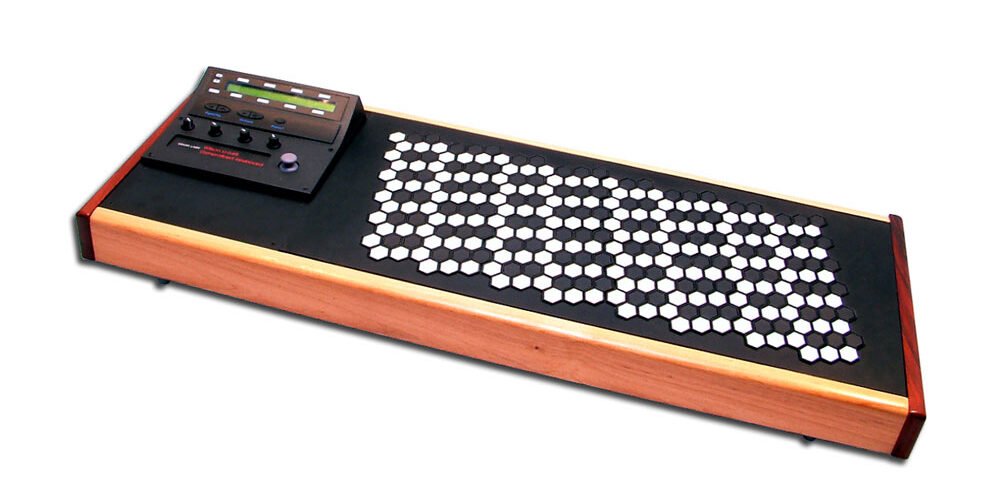
To overcome this limitation, Wilson developed the concept and design of the Generalized Keyboard (Generalized Keyboard) and devised methods for projecting orthomorphic grids.
The Principle of Isomorphism
The standard keyboard consists of a two-dimensional array of keys (often hexagonal) arranged in a plane. The horizontal and diagonal distances between the keys correspond to fixed frequency intervals.
The essential property of this interface is the fingering isomorphism:
- Any harmonic interval, chord, or progression retains exactly the same geometric shape and physical distance on the keyboard, regardless of the tonic note from which it starts.
- If a composer learns the fingering for a proportional triad or a Hexania chord in one position, he can transpose that chord to any other note by performing exactly the same hand position.
Wilson designed linear projection algorithms to translate the complex multidimensional structures of the Scale Tree and CPS sets to the two-dimensional surface of these keyboards, allowing the theoretical geometry of their tunings to become a practical, tactile, and instrumental experience for the performer.
Currently, there are instruments such as the Lumatone to reproduce those scales.

Conclusions
Ervin Wilson's work represents a monumental synthesis of theoretical acoustics, discrete mathematics, and musical practice. Far from being mere speculative curiosities, his findings demonstrated that the universe of musical tuning is not limited to the dichotomy between 12-TET compromise and unstructured chaos.
Through the Moments of Symmetry (MOS), Wilson discovered the mathematical laws that grant melodic integrity and coherence to linearly generated scales. With the Constant Structures, He extended this stability to multiboundary systems of high harmonic complexity. His analysis of Tree of Scales and from the sequences of Mount Meru It revealed the profound connection between continued fractions, the golden ratio, and the creation of self-reinforcing scales through psychoacoustic control of difference tones. Finally, the Combinatorial Product Sets (CPS) and the Generalized Keyboards They provided a geometric and spatial architecture that made this vast sonic universe navigable and executable.
The theoretical framework erected by Erv Wilson continues to be an irreplaceable source of inspiration and rigor for theorists, composers, mathematicians, and instrument designers in the contemporary music scene.
Citations and References
- Microtonality in Erv Wilson's Theory | PDF | Interval (Music) - Scribd, https://www.scribd.com/document/886300599/T-Narushima-Microtonality-and-the-Tuning-Systems-of-Erv-Wilson
- INTRODUCTION TO ERV WILSON'S MOMENTS OF SYMMETRY, https://www.anaphoria.com/wilsonintroMOS.html
- Full article: Elementary spectrum for the dissonance curve: from biophysics to number theory of musical harmony - Taylor & Francis, https://www.tandfonline.com/doi/full/10.1080/17459737.2026.2628778
- Introduction to Microtonality I: Moments of Symmetry : r/musictheory - Reddit, https://www.reddit.com/r/musictheory/comments/bfna3e/introduction_to_microtonality_i_moments_of/
- moment of symmetry, MOS - a musical linear tuning which has only two step sizes - Tonalsoft, http://www.tonalsoft.com/enc/m/mos.aspx
- MOS scale - Xenharmonic Wiki, https://en.xen.wiki/w/MOS_scale
- MOS Revisited - PitchGrid, https://pitchgrid.io/MOS_Revisited.pdf
- What other temperaments support these 12-tet scales? - Yahoo Tuning Groups Ultimate Backup, https://yahootuninggroupsultimatebackup.github.io/tuning/topicId_92040.html
- Brazilian Journal of Music and Mathematics - MusMat Research Group, https://musmat.org/wp-content/uploads/2017/10/MusMat-Journal-1st-issue.pdf
- 14-Note Scale in 16th Century Music | PDF - Scribd, https://www.scribd.com/document/283029752/02-WholeAlgorithms-microtonality-performance-eleven-musical-compositions
- Alternative Tunings: Theory, Notation and Practice - Tall Kite, https://tallkite.com/misc_files/alt-tuner_manual_and_primer.pdf
- INTRODUCTION TO ERV WILSON'S MT. MERU SCALES, https://www.anaphoria.com/wilsonintroMERU.html
- Music Theory (was Re: How to keep discussions on-topic) - Yahoo Tuning Groups Ultimate Backup, https://yahootuninggroupsultimatebackup.github.io/tuning/topicId_76975.html

[…] In Ervin Wilson's theory of Moments of Symmetry, the golden ratio is the perfect scale for creating microtonal recursion that never returns to the root or fundamental note. […]