
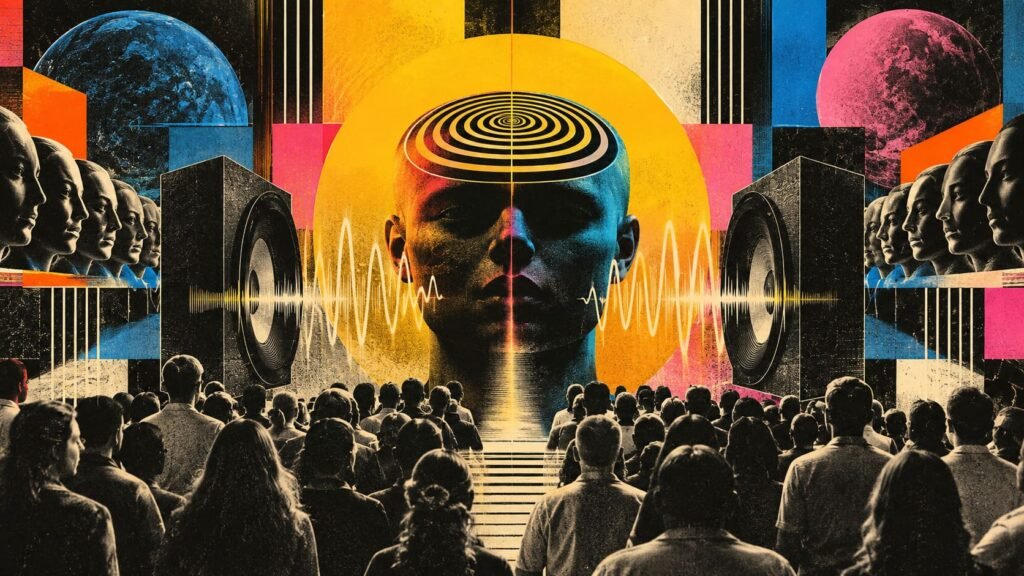
Music as a Social Programming Tool
Have you ever wondered if we are "programmed" through music?
A melody can make us walk in unison, recall a past era, lower our guard in the face of an advertisement, or sing along with strangers. This ability doesn't make music a form of mind control. But it does make it one of the most powerful social tools we have.
Direct answer
Music can influence social life because it organizes attention, emotion, memory, and synchronicity between people. It doesn't automatically program someone or eliminate their freedom. Its effect depends on who proposes it, the context in which it's heard, what is repeated, the accompanying story, and the meaning each listener gives it.
What does “social programming” mean when we talk about music?
The expression might sound obscure if we imagine a song planting an idea in the mind like a code. The reality is more interesting and complex. Here we use social programming to name the processes by which a community learns to feel, remember, celebrate, obey, protest, or belong around certain sounds.
A lullaby can teach calm. An anthem can forge an identity. A jingle can link a brand to a feeling. A protest song can sustain a crowd during a march. None of these effects happen in isolation in music: they emerge from the relationship between sound, lyrics, repetition, bodies, images, institutions, and memory.
Why can music have such a powerful influence?
Music brings together several things that normally appear separate: rhythm, voice, movement, emotion, and participation. That's why it can become a common framework even when not everyone shares the same words or experiences.
Synchrony
A shared pulse makes it easier for several people to sing, clap, march, or dance at the same time. Research on interpersonal synchrony associates it with social closeness and cooperation, although the results depend on the context and are not identical for everyone.
Emotion
Timbre, register, intensity, and rhythm can steer an experience toward tension, relief, solemnity, joy, or anticipation. This emotion can accompany a message, but it does not, on its own, determine its interpretation.
Memory
Family songs often trigger autobiographical memories and affect their emotional tone. That's why a melody can carry with it a time, a person, a movement, or a life experience.
Repetition and context
When a sound appears repeatedly alongside the same image, ceremony, brand, or slogan, we learn to associate them. Repetition doesn't force us; it simply makes a relationship more readily available in our memory.

Ritual: music as embodied memory
Before becoming a recorded product, music was—and still is—a situated practice: it is sung at births, funerals, religious ceremonies, festivals, harvests, healings, initiations, and community gatherings. In these contexts, it is not merely background noise. It marks when something begins, who participates, what is remembered, and how an important moment is experienced.
UNESCO describes rituals and festive events as practices that structure community life and reaffirm identity, continuity, and shared history. Songs, dances, gestures, and clothing can all come together. It's not about everyone experiencing the same thing; it's about having a common language to come together around something meaningful.
The song as a living archive
In many traditions, a song isn't primarily preserved in a museum or on a musical score: it's preserved because someone sings it again. This transmission can contain a language, a genealogy, a way of naming a landscape, or a way of coping with loss. Therefore, reducing music to "content" leaves out an essential part of its social function: it is also lived memory.
This idea helps explain why ritual repertoires spark intense debates. Changing lyrics, banning a song, or replacing it with another isn't just about altering the soundscape; sometimes it changes who can recognize themselves in a shared history. Cultural continuity is never static—music evolves as it circulates between generations—but neither is it indifferent to the power dynamics that determine which voices are archived, taught, or silenced.
From ritual to the public square: music can also sustain dissent
The power to unite people doesn't belong solely to governments or institutions. Songs have accompanied liberation movements, strikes, campaigns, fundraisers, and protests. The Library of Congress documents that spirituals, gospel, and folk music played a significant role in the civil rights movement: they were sung to motivate during marches and to find psychological strength in the face of harassment and violence.
This contrast matters. Music is neither inherently emancipatory nor inherently manipulative. Its ethical meaning relates to the conditions of participation, its purpose, the power that organizes it, and the possibility of questioning its message.
Music in war: signaling, coordination, morale and propaganda
In wartime contexts, music has served very specific functions. Drums, bugles, and trumpets were used to transmit orders in noisy and sprawling areas; marches helped coordinate movement; and songs accompanied daily life, farewells, commemorations, and mourning. The Library of Congress holds documentation of these uses during the American Civil War.
There is also a more dangerous political use: transforming collective emotion into unquestioning obedience or dressing up an ideology in grandeur, fear, or purity. The United States Holocaust Memorial Museum shows how the Nazi regime promoted certain repertoires, banned others, and disseminated songs and marches to reinforce commitment to the party and its ideological vision. This does not prove that a song alone can produce political conviction, nor does it explain historical violence through a single factor. It shows that cultural control and propaganda can include music as one piece within a much larger system.
When an emotion becomes recruitment
World War I provides another useful record for understanding this relationship. The Library of Congress holds tens of thousands of musical scores from the period and documents songs that supported mobilization, wartime morale, mourning, and also opposition to the conflict. This archive reveals something uncomfortable: music that today might sound naive or patriotic was then heard amidst social pressure, propaganda, family separation, and real violence.
The lesson is not that all patriotic emotion is suspect, nor that all war songs operate in the same way. It's that sound can make it easier to feel close to a cause before its consequences are even discussed. Hence the importance of looking at the entire ecosystem: lyrics, setting, funding institution, images surrounding the work, absent voices, and the freedom to dissent.

A map for listening to the social uses of music
| Context | Possible function | How it works | Ethical question |
|---|---|---|---|
| Ritual and ceremony | Marking transitions, memory, and belonging. | Repetition, participation, shared symbols, and collective time. | Do people understand and choose to participate in the proposed meaning? |
| War and State | To communicate, coordinate, commemorate, or raise morale. | Rhythm, march, repertoire, discipline, and public performance. | Does music accompany care and memory, or does it silence questioning? |
| Social movements | To sustain courage, to express demands, and to build solidarity. | Memorable lyrics, collective song, shared history, and participation. | Does it open up space for more voices and dignity, or does it replace thought with slogans? |
| Advertising and Media | Create attention, tone, recognition, and association with a brand or story. | Emotion, familiarity, audiovisual repetition, and context design. | Can we distinguish between the emotion we feel and the promise we are being sold? |
| Digital platforms | Guide discovery, habits and moods. | Lists, recommendations, autoplay, and attention metrics. | Who decides what gets repeated in our listening and with what interest? |
Media: the influence we almost never hear about
In a film, a news report, a trailer, a video game, a short video, or an advertisement, we often believe we respond only to images and words. But music can set the mood in which those images and words arrive: it brings back an intimate, threatening, epic, nostalgic, or funny scene before we can even explain it with words.
A review of experimental evidence on music in advertising identifies potential effects on attention, memory, attitudes, and purchase intention. This doesn't mean that a jingle automatically leads to a purchase. It means that sound is part of persuasive design and deserves the same level of consideration as spoken language, photography, or editing.
Today, that influence is more subtle because much of our listening is mediated by recommendation systems. A list "for concentration," "for healing," "for training," or "for sleep" can be helpful. But it also accustoms our ears to receiving pre-packaged moods. The question isn't whether we should distrust all recommendations; it's whether we should continue to set aside time to choose, search, compare, and listen without someone else deciding our next step.
The platform not only distributes: it also frames
A music platform doesn't create our taste on its own, but it can organize our access: what appears first, what plays next, what becomes familiar, and what fades from view. A playability study of music recommendations found biases toward more popular artists in various algorithms evaluated using Last.fm data. This doesn't allow us to conclude that all platforms work the same way, nor does it describe every current catalog; however, it does offer a concrete reason not to consider recommendations as a neutral platform.
There's an important difference between honest human curation and an automated path optimized to hold attention. The former might share a common criterion, a local scene, a sense of slow listening, or a story. The latter might be very comfortable, but it rarely explains why one song came before another. Reclaiming agency doesn't require abandoning technology; it requires alternating comfort with deliberate exploration, credits, full albums, community radio, independent labels, and conversations among listeners.

“Inspiration” also deserves questions
Music inspires us because it can awaken images, desires, memories, and inner movements. That experience is valuable. The problem begins when we call any intense emotion inspiration and stop asking who designed the context, what purpose the message serves, or what response it's trying to elicit.
Being inspired is not about obeying. A conscious listener can receive a song deeply while maintaining critical thinking. We can allow ourselves to be moved without giving up on asking where a work comes from, what it normalizes, who benefits from it, and what part of ourselves it is appealing to.
Persuasion, manipulation, and participation are not the same thing
Every musical work proposes something: a pulse, an emotion, a way of imagining time. That doesn't automatically make it manipulative. The ethical difference arises when the intention is concealed, a vulnerability is exploited, the possibility of response is reduced, or a particular interest is presented as if it were the only legitimate emotion of a group.
| Sign | Creative and open influence | Influence that warrants alert | Possible answer |
|---|---|---|---|
| Intention | The context, authorship, and purpose are identifiable. | Interest is disguised or hidden behind a seemingly spontaneous emotion. | Look for credits, sponsorship, context, and sources. |
| Stake | There is room to interpret, respond, modify, or not participate. | Belonging demands adherence and punishes doubt or disagreement. | He retains the right to pause, compare, and dissent. |
| Repetition | It deepens a cultural practice that people recognize and choose. | It seeks to make an association automatic without leaving time to think about it. | Break the routine: listen to versions, silences and alternatives. |
| Consequence | It expands sensitivity, dialogue, care, or shared imagination. | It dehumanizes, simplifies the adversary, or turns fear into obedience. | Ask who is affected and what behavior is being normalized. |
Four questions to regain listening skills
01
What do I feel?
Name the state that the music proposes before turning it into a conclusion about the world.
02
What is it associated with?
Notice what image, brand, story, ritual, or identity always appears alongside that sound.
03
Who decides?
Ask who chose the music, for what purpose, and what alternatives were left out.
04
What do I choose?
Build an active relationship: sing, play, create your own playlists, and talk about what you're listening to.
Listening again is regaining a form of freedom
The answer isn't to live in constant suspicion or turn every song into an exam. It's to develop sensitivity. When we understand that a march, an anthem, a choir, a soundtrack, or an automated playlist organizes something more than just sound, we can decide more freely how to participate.
Music will continue to inspire because it's meant to touch parts of us that explanations can't always reach. That's its beauty and also its responsibility. Those who create music can ask themselves what it invites us to feel and do. Those who listen can ask themselves what relationship they wish to build with that which moves them from within.

Learning music is also learning to listen
At Legatto, we explore music as technique, creativity, listening, and our relationship with the world. Discover our music classes and experiences, Discover our methodology or experiment with sound patterns in Scale Studio.
Frequently Asked Questions
Can music control people's minds?
There is no basis for understanding music as an automatic form of mind control. It can influence emotion, attention, memory, and social coordination, but its effects depend on the individual, the context, prior relationships, and the ability to interpret or question what they hear.
Why is music used in rituals and ceremonies?
Because it helps to organize shared time, transmit memories, accompany important transitions, and reinforce a sense of belonging. Songs, dances, and gestures acquire meaning within the history of each community.
How has music been used in war?
It has served for communication and coordination through signals, to accompany marches and ceremonies, and to boost morale or commemorate events. It can also be integrated into propaganda apparatuses, and therefore must always be understood within its political and historical context.
Does music in advertising manipulate the listener?
Music can influence attention, memory, and attitude toward an advertisement, but it doesn't, on its own, determine a purchase decision. Recognizing its persuasive function allows for a more conscious and discerning reception of it.
How can I listen to music more mindfully?
Take a moment to notice what emotion it evokes, what images or messages accompany it, who chose that sound, and what you would like to choose. Alternate between automatic playback and moments of searching, attentive listening, musical practice, and conversation.
Sources and for further exploration
- Music and social bonding: self-other merging and neurohormonal mechanisms. Review on synchrony, social bonding and music; describes proposed mechanisms and their limitations.
- Prosocial Consequences of Interpersonal Synchrony: A Meta-Analysis. Synthesis of studies on synchrony and prosocial behavior.
- Music, memory and emotion. Review of associations between music, emotion and autobiographical memory.
- UNESCO — Social practices, rituals and festive events. The role of rituals, songs, and dances in community identity and continuity.
- Library of Congress—Civil War Music. Drumming, bugle playing, and repertoire during the war.
- Library of Congress — World War I Sheet Music: Major Themes. Context of propaganda, popular music and mobilization during the First World War.
- United States Holocaust Memorial Museum—Culture in the Third Reich. Nazi cultural policy, censorship and use of songs and marches; a historical case that requires context.
- Library of Congress—Music in the Civil Rights Movement. Music to sustain spirit, unity, and collective action.
- Sound advertising: review of experimental evidence. Review of attention, memory, attitudes and purchase intention in music advertising.
- The Unfairness of Popularity Bias in Music Recommendation. Reproducibility study on popularity biases in music recommendation systems; does not describe all platforms on its own.
- Sara Cottle / Unsplash, Te Papa / Unsplash, Nice M Nshuti / Unsplash and Rafael Garcin / Unsplash. Interior images licensed under Unsplash.
