
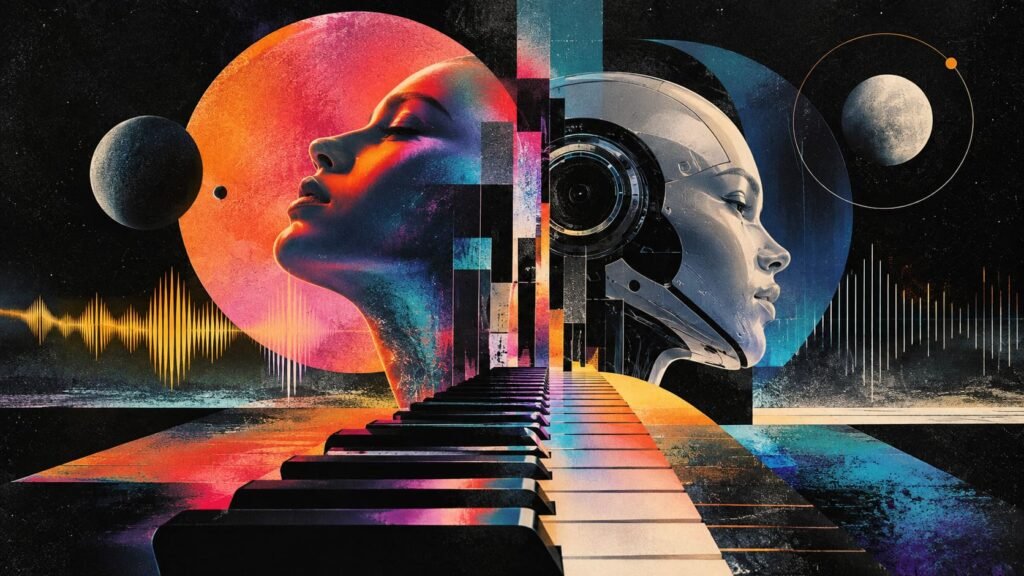
The role of AI in music
Artificial intelligence can now suggest melodies, transform a voice, separate instruments, generate accompaniments, and produce complete songs in seconds. Tools like Suno and Udio have made this possibility accessible to almost anyone. Given this speed, it's natural to wonder if human creativity is losing its place.
AI can radically alter how music is produced and distributed, but it does not eliminate the need for artists. On the contrary: the easier it is to manufacture sound, the more value there will be for identity, judgment, presence, and the human ability to make someone feel something real.
The threat is not a machine that “makes music”
Tools have always changed music. Recording transformed performance; synthesizers expanded timbre; software turned a computer into a studio. AI is different because of its speed and the scale at which it can produce, imitate, and distribute material.
The problem arises when that power erases consent, confuses the public, or fills listening spaces with content designed solely to capture attention and royalties. Not every song created with AI is a hoax. Not every human-made song is honest. But there are concrete risks worth mentioning.
Voices and identities without permission
A voice is not simply an interchangeable color. Clones who unauthorizedly imitate a person's name, voice, image, or recognizable style can deceive the public and damage the relationship between artist and audience.
Fictional artists and confusion
A project can be presented as if there were a biography, an experience, or a person behind it when in reality none exists. The risk isn't the declared artistic fiction: it's deliberately concealing who created, performs, or controls the work.
Saturation and fraud
The ease of uploading thousands of tracks can dilute attention and facilitate manipulation of streams. Deezer and Spotify have already announced measures for labeling, profile protection, and spam filtering.
Models without transparency
It's also important to know where a tool learns from, what permissions exist, and how the people whose work made that learning possible will be compensated. It's a technical, economic, and profoundly human conversation.
But a tool doesn't have to be a replacement
The same technology can be used in very different ways. It can help a person overcome a physical barrier, organize a session, find a variation they hadn't imagined, or transform a sketch into a starting point. In these cases, AI doesn't replace the artist: it expands their creative space.
Sketches and exploration
It can generate quick alternatives of rhythm, texture or instrumentation to listen to possibilities before deciding what to develop in depth.
Accessibility
Transcription tools, audio separation, voice assistance, or voice control can open doors for people with different technical abilities and experiences.
Active learning
When used properly, a tool can be used to compare arrangements, isolate elements, test tunings, or turn a musical question into an audible experiment.
Time for what matters
Automating repetitive tasks can free up energy for writing, rehearsing, recording, playing with others, and making better artistic decisions.

Suno, Udio, and prompt-speed creation
Suno, Udio, and similar applications are not simply "buttons for making songs." They are environments where a description, lyrics, an audio reference, or a brief idea can be transformed into an audible test. Udio, for example, allows you to guide a generation through descriptions of style, instrumentation, mood, and theme; Suno even allows you to start with a fragment of your own audio. Udio and Suno They document these functions in their own help centers.
This can be fertile ground for initial exploration. A composer can compare atmospheres with their band before producing them; a beginner can listen to how an idea changes when tempo, instrumentation, or register are altered; someone can use their own sketch as a question, not as a finished piece. But speed also invites confusion. trigger with create.
A healthy practice: Use these apps like a sketchbook. Save what sparks your own decision and bring it back to your instrument, your voice, your session, or your stage. If nothing you do transforms the result, perhaps it's not yet a work of art: it's a possibility waiting to be seen.
Spotify, Deezer and the battle for trust
The change doesn't just happen where music is created; it happens where it's discovered. Spotify, Deezer, and other streaming services decide how profiles, credits, and recommendations appear. That's why artist identity, tagging, and traceability are no longer administrative details: they help listeners know who they're connecting with.
Spotify announced specific protections against unauthorized voice impersonation, fraudulent delivery of releases to unauthorized profiles, and bulk upload spam. It also introduced AI credits and labels for profiles whose public identity is generated by AI. Spotify's privacy policy and his AI-generated identity tag They show that the problem is already part of the platform design.
Deezer, for its part, states that it labels tracks entirely generated by AI, excludes them from its recommendations, and combats inauthentic playback. This doesn't mean that one platform has solved the entire problem, nor that every case can be detected automatically. It means that transparency and the protection of human royalties are now part of the public conversation surrounding streaming.

Reality does not mean "without technology"“
Being a true artist isn't about rejecting every new tool. An electric guitar, a pedal, a sampler, and a microphone have all played a role in shaping the relationship between a person and sound. Authenticity emerges when someone owns their choices, stands by them, and builds an honest connection with their listener.
Authenticity can become more visible
This is an interpretation, not a guaranteed prediction: in an environment flooded with interchangeable music, it will probably be easier to recognize the value of a voice with a story, a unique performance, a concert where something truly happens, and a work that reveals a distinctive perspective. AI can participate in the process; it cannot live for the artist what the work needs to express.
What can an artist offer who doesn't fit into a prompt?
A life
Experiences, memory, body, relationships, and consequences. Not as decoration, but as the material of a work.
Criterion
Knowing what to delete, when to remain silent, and why one version is more true than another.
Presence
Shared listening, the risk of playing live, and the human response that happens in the moment.
Relationship
A community does not just follow sounds: it accompanies a search, a voice, and a way of being in the world.
How to use AI without giving up your voice
There is no single rule for all projects, but these questions can guide more conscious use:
- What decision should I continue to make? If the answer is "none", perhaps the tool is replacing exploration instead of serving it.
- Is there consent? Do not use another person's voice, identity, work, or likeness as raw material without clear permission.
- Can I explain my process? Transparency does not require revealing every technical detail; it does allow preventing a fabricated identity from being presented as a real person.
- Does the result say anything worth defending? The ease of generating does not exempt us from carefully choosing what we put into circulation.
A note on rights: The rules vary depending on the country, platform, and specific use. For reference, the U.S. Copyright Office maintains that a work with AI input can be protected when a human determines sufficient expressive elements; a prompt alone does not establish authorship. This does not replace legal advice for a specific case.
Music doesn't need to sound human: it needs to touch humans
Perhaps the most useful question isn't "Can AI make better songs?" A song can be technically flawless and still leave no lasting impression. The question is: What kind of relationship do we want to build with music?
In the coming years, we may hear a vast number of songs made without an identifiable person behind them. Therefore, uniqueness will no longer be a luxury. It will be a form of self-care. Artists who cultivate their language, their presence, and their relationship with the audience will not only compete for attention: they will offer something that cannot be fully automated, an experience of connection.

Your creativity is not in danger if it keeps moving.
At Legatto, we explore music through listening, technique, intuition, and personal creation. Discover our music classes and experiences, Discover our methodology or use Scale Studio to expand your musical language.
Frequently Asked Questions
Will AI replace musicians?
It can automate or accelerate some tasks and produce synthetic music on a large scale, but it does not by itself replace the identity, judgment, interpretation, or human relationship that an artist builds with their audience.
Is it bad to use AI to make music?
Not necessarily. It can be useful for exploring ideas, learning, transforming audio, or saving time. The difference lies in using it with intention, transparency, and respect for the rights and identities of others.
What are Suno and Udio?
These are AI-powered music generation apps. They allow you to create and modify music based on instructions, lyrics, parameters, or, depending on the function, your own audio. They can be useful for exploring sketches, but a tool doesn't replace a person's artistic decisions.
What risks does AI pose to music?
Risks include unauthorized voice clones, fictitious identities presented as real, lack of transparency regarding model training, content saturation, and playback fraud.
Can a song made with AI be copyrighted?
It depends on the jurisdiction and the level of human contribution. In the United States, the Copyright Office indicates that a work incorporating AI may be protectable when a person determines sufficient expressive elements; a prompt alone is not enough.
Sources and for further exploration
- US Copyright Office — Report on Copyright and Artificial Intelligence, Part 2. Human authorship and works incorporating AI.
- IFPI — Creating an Environment in which Music and Creators can thrive. Unauthorized voice and identity cloning and principles for responsible AI.
- CISAC/PMP Strategy — Global economic study on generative AI. Economic impact projections should be read as estimates, not certainties.
- Deezer — Music fully generated by AI. Data on uploading synthetic music, tagging, and playback fraud on their platform.
- Spotify — Strengthens AI Protections for Artists, Songwriters, and Producers. Voice impersonation, spam, and AI credits policy.
- Spotify — Label for AI-generated artist profiles. Transparency regarding AI-generated artist identities.
- Suno Help — Create Music with Audio and Udio Help — Create Your First Song. Examples of functions and generation flows of these tools.
- US Copyright Office — Copyright and Artificial Intelligence. Resources and limitations of the initiative; legal application varies by jurisdiction.
