
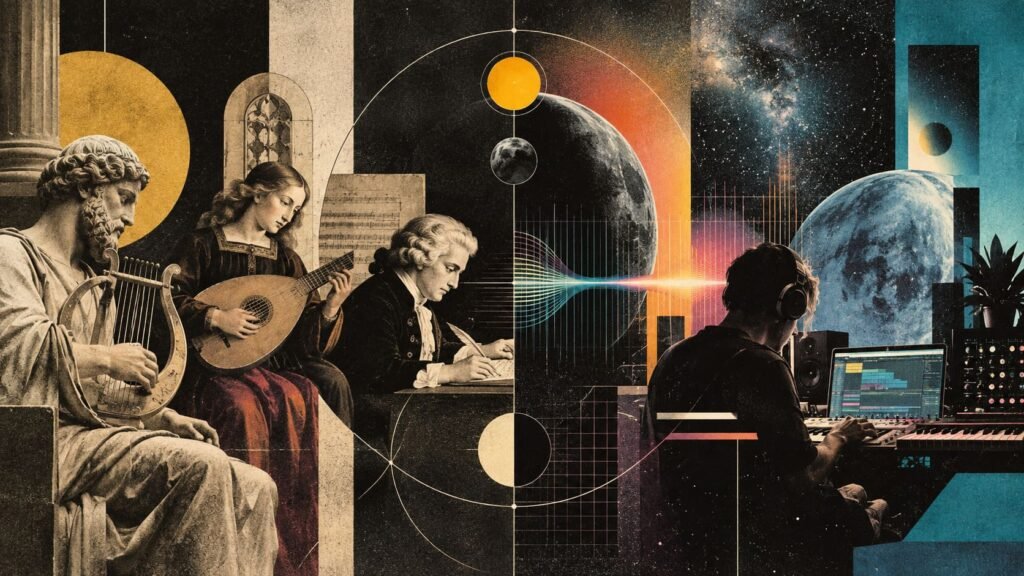
How much has the way of creating music changed?
A song today can begin with a voice recorded on a phone, a guitar, a modular synthesizer, a programmed rhythm, or an idea written for a machine. But the interesting question isn't whether technology changed music. It's what new possibilities it opened up for the imagination.
Direct answer
The way music is created has changed profoundly: We've gone from relying almost entirely on performers, instruments, and physical venues to being able to record, transform, connect, tune, and share sound using increasingly accessible tools. The essential element, however, remains: someone listens, decides, and shapes an experience.
Music wasn't always created as we know it today.
For centuries, composing meant imagining a work for voices or instruments and committing it to music, rehearsal, or live performance. Music existed only as long as someone played it. Recording changed that relationship: for the first time, a performance could be repeated, travel, and become material to be listened to again.
Over time, the studio ceased to be merely a place to document a song. It also became an instrument. Cutting tape, layering takes, speeding up a vocal track, or changing the order of sounds allowed for a different approach to songwriting.
01 · RECORD
The sound is preserved
The performance doesn't disappear when it ends. It can be listened to again, edited, and shared with other people.
02 · SYNTHESIZE
The doorbell is designed
Oscillators, filters, and envelopes turn the question "what instrument do I use?" into "what sound do I imagine?".
03 · CONNECT
Music becomes data
MIDI allows instruments and computers to exchange musical instructions without being the sound itself.
04 · EXPAND
The studio fits at home
Software, networks, and digital tools reduce barriers and multiply ways to collaborate and publish.
Sound synthesis changed the question
A synthesizer is not just a machine that imitates instruments. Its most exciting promise is something else: create stamps that did not exist before. A simple wave can be filtered, modulated, and transformed until it acquires movement, texture, and character.
This opened up a new sensibility. Sound ceased to be merely the vehicle for a melody or a chord; it could also be the center of the work. Sound design, electronic music, and much of contemporary production stem from this attention to color, attack, space, and the transformation of timbre.
The Beatles and the studio as a space of invention
The Beatles didn't invent multitrack recording or tape effects, but they helped show a massive audience that the studio could be creatively involved in a song. At Abbey Road, they explored techniques such as artificial double-tracking (ADT), speed changes, phasing, and tape loops. The Abbey Road Archives They document, for example, the use of multiple loops in Revolution 9.
The lesson isn't "use a lot of effects." It's simpler: when a tool is used intentionally, it can become part of the composition. Sometimes a song needs an unaltered guitar. Sometimes it needs a voice that's impossible to achieve without a tape, a filter, or editing.
Late 20th century: when instruments learned to converse
The arrival of MIDI in 1983 marked a decisive change. MIDI doesn't carry audio: it carries information such as notes, program changes, and expression controls. This is why a keyboard, a sequencer, and a computer could coordinate even though each produced its own sound. MIDI Association It places the initial MIDI 1.0 specification in August 1983.
Along with samplers, drum machines, and sequencers, MIDI made it possible to repeat, shift, quantize, orchestrate, and automate musical ideas with unprecedented precision. It also changed access: a large studio still had advantages, but it was no longer the only place where a complex production could be born.
What is changing now?
Today there is not just one border. There are many, and they intersect.
Accessible production
A digital workstation allows you to record, edit, mix, and test arrangements from a small computer. Technical ease doesn't replace judgment, but it frees up time for exploration.
Remote collaboration
An idea can travel between cities in the form of audio, projects, stems, or scores. Distance transforms from an obstacle into a creative condition.
Expressive instruments
New controllers, sensors, and protocols expand the way of playing: pressure, sliding, gestures, and tuning can all be part of the same performance.
AI as a tool
Artificial intelligence can help with sketching, audio separation, voice transformation, finding variations, or generating material. Its output does not replace the listening, taste, or responsibility of the creator.
AI cannot answer on its own what music is worth making
Artificial intelligence highlights an important difference: producing a lot of material doesn't necessarily equate to creating a work of art. A tool can suggest a texture, a progression, or a starting point. The musician still decides what to keep, what to discard, what to transform, and for whom it makes sense to say something.
It also demands ethical judgment. Before using other people's voices, works, identifiable styles, or materials, it's advisable to consider permission, attribution, terms of use, and context. The speed of a tool does not eliminate creative responsibility.
Erv Wilson: Open up the scale, not just the studio
Musical innovation doesn't just happen in devices. It also happens in the way sound is organized. Erv Wilson, A complete unknown, he dedicated much of his work to microtonal scales, just intonation, keyboard designs, and structures such as the Combination Product Sets. These are not "weird scales" to decorate a song: they are ways of exploring relationships between pitches outside the usual twelve-note grid.
The authorized collection of the Wilson Archives It brings together his research; its chronology places the development of the Hexany and other CPS in 1969. What is fascinating is that current digital tools make it more accessible to listen, tune and compose with ideas that for decades were the territory of specialized instruments and small communities.
Creating music today means choosing limits.
We have more sounds, more tracks, more plugins, more references, and more options than ever before. That can be liberating, but it can also be paralyzing. That's why a creative practice isn't just about adding possibilities: it's about choosing which ones to leave out.
A simple way to start could be this:
- Choose a tool that you don't yet know well;
- Set yourself a clear restriction, such as working with four tracks or a single scale;
- Record a short idea before attempting to finish a song;
- Listen the next day and decide what has a life of its own.
The future of music creation will likely not be defined by a single dominant technology. It will be a coexistence of them: acoustic instruments, synthesis, recording, software, new tunings, human collaboration, and artificial intelligence. The question will remain intimate and timeless: What do you want to hear that doesn't exist yet?
Technology can amplify your hearing
At Legatto, we understand musical creation as an encounter between technique, intuition, curiosity, and practice. Explore our music classes and experiences, Discover our methodology or experiment with scales in Scale Studio.
Frequently Asked Questions
Has technology replaced musicians?
No. Technology changes the tools, workflows, and sounds available, but a work still needs human decisions: listening, intention, interpretation, selection, and context.
What did synthesis contribute to music?
Synthesis made it possible to design timbres using elements such as oscillators, filters, and envelopes. In addition to imitating sounds, it opened up sonic possibilities that were not dependent on existing acoustic instruments.
Why was MIDI so important?
Because it standardized the exchange of musical information between instruments, sequencers, and computers. It doesn't transmit audio, but rather instructions such as notes, controls, and program changes.
What is Erv Wilson's relationship to contemporary music?
His research on tuning, scales, keyboards, and microtonal structures offers ways to organize pitches beyond the usual twelve notes. Today, software makes it easier to explore many of those ideas.
Sources and for further exploration
- Abbey Road Studios — The Beatles: White Album. Recording resources, tape loops, phasing, varispeed and ADT.
- MIDI Association—MIDI History, Chapter 7. History and initial specification of MIDI 1.0.
- MIDI Association—MIDI 1.0 Core Specifications. What information does MIDI allow you to exchange?.
- Wilson Archives — Erv Wilson. Authorized archive of his research on microtonality and just tuning.
- Wilson Archives — Combination Product Sets. Introduction to CPS and its musical logic.
- OpenAI — Jukebox. Historical example of research on audio music generation.
