
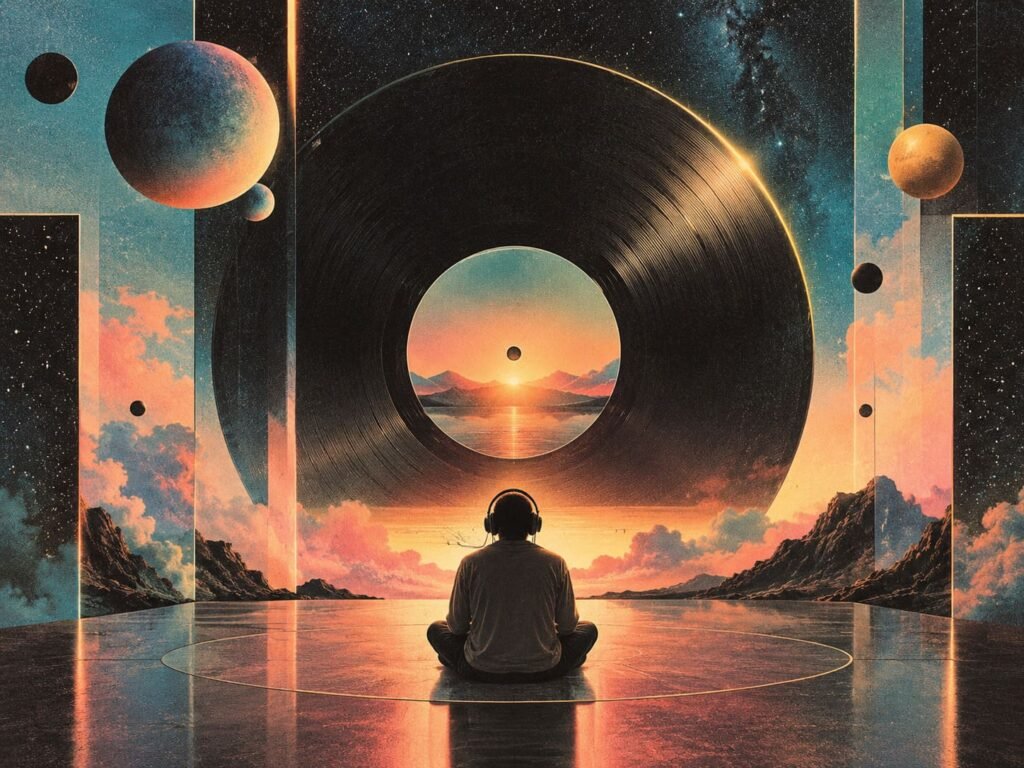
The art of listening to a whole album
An album is more than just a collection of songs. It can be a room with its own light, an emotional map, a conversation of sounds, or a journey where one piece transforms when placed next to another. Listening to it in its entirety means accepting, for a while, the order that someone envisioned.
Listening to a full album allows you to perceive relationships that a single or shuffle usually hides: order, contrast, transitions, recurrences, and silences. It is not a “superior” way of listening; it is a different practice, especially valuable when a work was conceived as a journey.
From fragment to journey
Singles are wonderful for discovering artists, sharing a fleeting emotion, or revisiting a song we need. Shuffle can also lead to unexpected encounters. There's nothing wrong with either of these ways of listening. But both shift the scale of attention: they privilege the isolated moment.
An album, on the other hand, can work with duration. A first song opens a door; a second contradicts the promise; an interlude cleanses the ear; an ending leaves a question. Sometimes the sequence responds only to energy and tonality. Sometimes it constructs an explicit narrative. In both cases, the order is part of the composition.
What becomes audible when we don't skip tracks
Architecture
The beginning, the turning points, and the ending are perceived as decisions. A song can be a bridge, a respite, a manifesto, or a consequence of the previous one.
Stamp family
The repetition of a texture, an instrument, or a way of recording can create a recognizable world even when the songs are different.
Contrast
A slow piece can have a different weight after an intense one. Volume, tonality, silence, and density converse with each other.
Memory
A recurring motif at the end ceases to be a detail: it becomes a trace that connected the entire journey.

The shuffle isn't the enemy, but it changes the work.
Random playback breaks the sequence to generate a different logic: that of surprise. It can reveal similarities between disparate artists or accompany an activity without demanding continuous attention. The problem arises only when we believe that this random order is equivalent to any other.
If an artist composed transitions, designed fades, chose a cover, separated sides, or placed a delicate track after an exuberant one, the shuffle transforms that arrangement. It doesn't necessarily destroy it; it remixes it. Recognizing this gives us the freedom to choose when we want one thing and when we want the other.
| Mode | What does it privilege? | Question that opens |
|---|---|---|
| Single | Immediate impact and personal affinity. | What is it about this song that makes me want to listen to it again? |
| Shuffle | Surprise, discovery and a mix of contexts. | What connections emerge when order becomes random? |
| Full album | Sequence, contrast and sound world. | What was the purpose of this song to make possible by being here and not somewhere else? |
How to do a complete listening session without turning it into a rigid ceremony
You don't need to shut out the world, buy expensive equipment, or adopt a solemn demeanor. Simply adjust the context a little. Choose an album you don't know or one you thought you knew. Listen to it in order, without looking at your phone for the first three songs and without changing the track as soon as something doesn't grab you. Then, take note of a transition, a recurring sound, or a song that changed its meaning because of its proximity.
An experiment for this week: Listen to an album twice. The first time, just go along with it. The second time, take note of where the energy shifts, which track acts as a threshold, and which sequencing choice feels essential. You don't need to arrive at a "correct interpretation"; simply train your attention for a longer period.
It's also a lesson for the composer
Composing an album doesn't require all the songs to share a genre or tell a literal story. It requires thinking about relationships. Which song best opens up the world? Which one needs breathing room? Which idea deserves to return at the end? Which one would be too strong if it appeared earlier?
When a work is well-ordered, each track retains its autonomy while simultaneously gaining a second life within the whole. The sequencing isn't just a formality after recording: it can reveal what the project is truly about.

Music is also learned by listening to its form
At Legatto, we explore listening as a creative practice. Discover our classes, Discover the methodology or accompany your project in a musical mentoring.
Frequently Asked Questions
Why listen to a whole album?
Because it allows you to perceive its sequence, transitions, contrasts, and recurring motifs. It's useful when the songs were conceived as a whole, although it doesn't replace other valid ways of listening to music.
Does shuffle ruin an album?
Not necessarily. It creates a different experience by altering the order. If you want to understand the intended sequence of a piece, it's best to listen to it once in the order chosen by the artist.
How to listen to music more attentively?
Choose a piece, listen to it in order, minimize interruptions, and take note of any recurring transitions or details. Attention is trained through curiosity, not rigidity.
Does an album need to tell a story?
No. It can have an explicit narrative, but it can also work through atmosphere, energy, timbres, contrasts, or exploration of the same sound language.
Sources and to continue listening
- Library of Congress—National Jukebox. Archive for exploring recorded music as heritage and historical context.
- How Live Music Moves Us. Study on attention and bodily response in listening to live and recorded music.
- Unsplash — collections and real_jansen / Unsplash. Interior images licensed under Unsplash.
