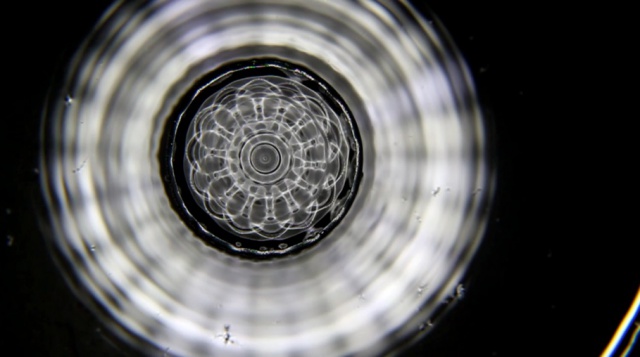
Cymatics: The Invisible Architecture of Sound
Human perception of sound is often limited to an ephemeral experience: variations in air pressure that our ears translate into music, noise, or words. However, behind this sensory experience lies a physical, tangible, and deeply structured reality. What if you could see Your favorite song?
Welcome to the fascinating world of cymatics, The bridge where the abstract phenomenon of acoustics meets the concrete manifestation of geometry. Through sound, vibration ceases to be invisible and becomes an architect that organizes matter into patterns of astonishing complexity.

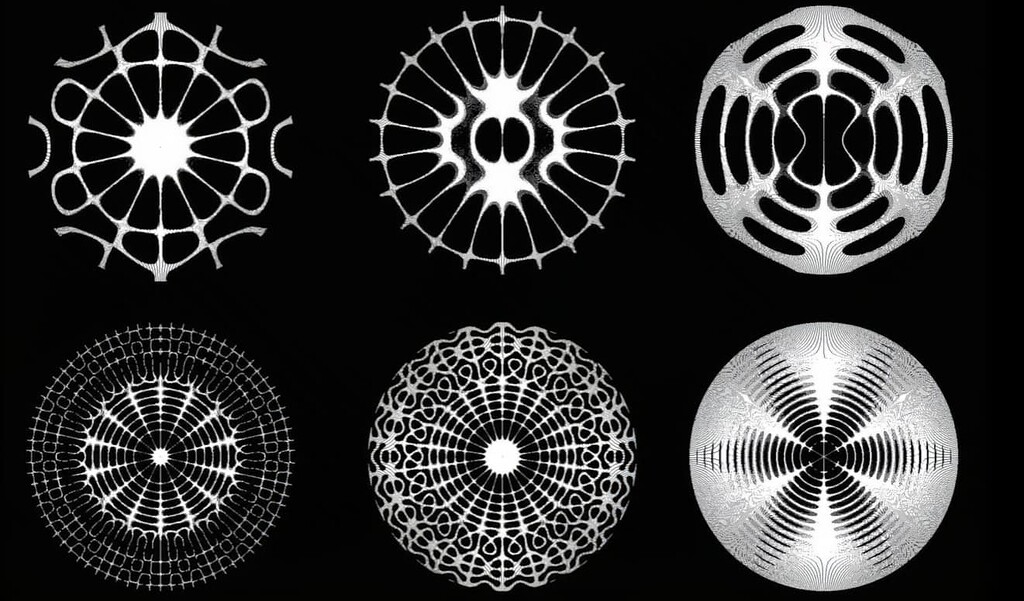
The word cymatics It was coined in the 20th century by the Swiss physician and scientist Hans Jenny, deriving from the Greek term kyma, The word "wave" comes from the Greek word for "wave." However, human wonder at the hidden geometry of sound has much older roots. In the 18th century, the physicist Ernst Chladni—known today as the father of acoustics—began to reveal (or remind) the world of this secret. By rubbing a violin bow against the edge of metal plates sprinkled with fine sand, he discovered that specific frequencies caused the sand to dance and spontaneously arrange itself into perfectly symmetrical geometric mandalas. Chladni empirically demonstrated that music is not only heard; it also occupies space, has structure, and possesses physical form.

But cymatics represents something far beyond a beautiful and curious laboratory experiment. It is the visual and scientific confirmation of what ancient traditions, from the Pythagorean philosophies of the "music of the spheres" to the creators of mantras and age-old chants, have always intuited: We live in an inherently vibratory universe. It reveals to us that sound is not a simple byproduct of colliding matter, but rather Sound is the primal force that molds the matter.
Understanding this completely changes our relationship with the environment and with the art we create. It invites us to realize that the frequencies we emit, the instruments we tune, the music we produce, and even the words we speak do not vanish into thin air. On the contrary, they are constantly interacting with the fabric of reality, sculpting energy fields at both microscopic and macroscopic levels. Cymatics is, in essence, the visual translation of nature's hidden language, showing us that the world's apparent chaos is sustained by an underlying harmonic order.

The mechanism: From oscillation to form
To understand how sound generates geometry, we must remember that everything in the universe vibrates. Sound is a pressure wave that travels through compression cycles via a medium (gas, liquid, or solid). The magic happens when these waves encounter a physical boundary, such as the edge of a container or a metal plate, creating standing waves.
Within this vibrant dance, two protagonists emerge:
- The Nodes: Lines of profound stillness where the waves cancel each other out.
- The Antinodes: Areas of maximum oscillation and energy.
If we sprinkle sand onto a metal plate and vibrate it, the grains of sand are violently ejected from the antinodes and seek refuge in the absolute stillness of the nodes. The result is a beautiful geometric pattern that reveals the internal architecture of that frequency.
At Legatto we developed an application to visualize the patterns that Chladni classified.
The truth about 432 Hz and the "Vessel""
At Legatto, we've previously discussed the debate between 440 Hz and 432 Hz. Cymatics offers a revealing and scientific perspective to debunk some popular beliefs.

Videos often appear online where the 432 Hz frequency produces an aesthetically "perfect" pattern, attributing sacred properties to it. However, acoustic physics teaches us that There is no universal form for a given frequency.. The cymatic image is an intimate collaboration between frequency and the variables of its environment (the size of the container, the density of the liquid, the temperature).
If the platter diameter changes by just a few millimeters, those 432 Hz could create visual chaos, while the 440 Hz could be aligned in perfect symmetry. Beauty doesn't reside in an isolated number (whose unit of measurement, the "second," is a human invention), but in the Perfect harmony between the vibration and the space it inhabits..
Sound as the Architect of Life
Modern discoveries with instruments such as the CymaScope (which uses ultra-high purity water to capture the holographic and three-dimensional nature of vibration) are suggesting something profound: the geometry of nature could have sonic roots.