
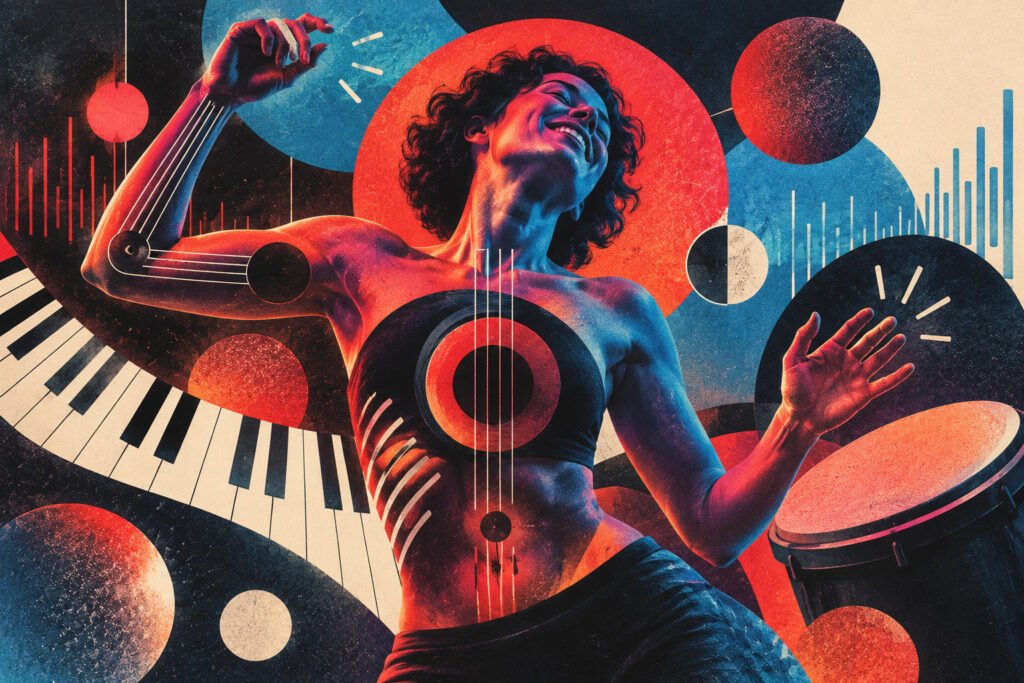
The body as the first musical instrument
Before a guitar, a keyboard, or an app, there was already breath, voice, clapping, and footsteps. The body doesn't just perform the music: it perceives the pulse, anticipates what's coming, and gives sound a human form.

The music starts before it plays.
When someone taps their foot to a beat, sings a phrase unaccompanied, or claps in response to another person, they are already organizing time, energy, and attention. This organization doesn't happen solely "in the head." Research on embodied musical cognition describes listening as a process where perception, movement, and prediction intertwine: the listener often senses where a rhythm is going, even when standing still.
This explains something commonplace: the same song can invite you to sway, hold your breath, or walk with a different step. Not because the body receives exact commands, but because it finds possibilities for movement in the pulse, the accents, the articulation, and the sonic energy.
Four resources you already have with you
- 01
Breathing
It provides phrasing, pauses, and direction. A vocal melody often reveals where it needs breath, and that need can suggest the size of an instrumental line.
- 02
Voice
It's pitch, timbre, and language. Humming an idea before searching for chords helps preserve its outline without relying on a screen or a familiar fingering.
- 03
Hands
Clapping, tapping, and snapping allow us to test subdivisions. They also teach that rhythm isn't a grid: it has weight, bounce, and space.
- 04
Posture and movement
Walking, bending, or remaining still shifts the focus. A gesture can be a pre-score: opening up in a chorus, shrinking back in a verse, cutting off abruptly before returning.
| Body element | What he trains | An immediate test |
|---|---|---|
| Walking the pulse | Regularity and relationship with tempo. | Walk while listening to a song; identify the moments when your pace wants to change. |
| Offbeat palms | Independence and listening to the gaps. | Tap your foot to the beats and clap between them for eight measures. |
| Humming without lyrics | Melodic memory and breathing. | Create two sentences: one that asks a question and one that answers. |
| Silent gesture | Dynamics, intention and form. | Conduct a ten-second crescendo with your arms and then play it with your voice or an instrument. |
Body Percussion: the body as a portable drum set
Body percussion is the practice of using one's own body as a percussion instrument. Clapping, finger snaps, tapping on the chest, thighs, or feet, and even the rubbing of hands on clothing create an immediate orchestra, without the need for external objects. It is not a recent invention: it appears in traditions all over the world and has become a central tool in contemporary music education because it directly combines rhythm, coordination, listening, and expression.
The interesting thing isn't just producing sounds, but discovering that each part of the body offers a distinct timbre. An open clap sounds brighter and shorter; a chest pound is deeper and rounder; a stomp adds weight and resonance. This variety of textures allows you to build rhythmic phrases with the same logic a drummer uses to choose between snare, bass drum, and bass drum.
Furthermore, body percussion trains something that many musicians take years to develop with an instrument: limb independence and the ability to listen to the whole while participating in it. When you tap out the beat with your feet, a syncopated rhythm with your hands, and an accent with your voice, you're practicing polyrhythms in the most natural way possible.
A simple sequence to try right now:
- Feet: marks a constant pulse (one-two-three-four).
- Hands: add a clap on the second and fourth beats.
- Chest or thighs: introduces a soft tap on the "and" of each beat (the subdivisions).
- Voice: say or sing a short syllable on the strong accents.
Don't aim for absolute precision at first. Focus on the feeling of your body conversing with itself. Later, you can transfer that same feeling to an instrument: the attack, weight, and spacing between notes will become clearer.
The body does not replace the instrument: it makes it expressive.
It might seem that technique is the opposite of the physical: metronome, repetition, precision. In reality, useful technique refines the relationship between intention and result. A guitar responds differently depending on the attack; a piano note changes according to its weight and speed; a voice needs to coordinate ear, breath, and articulation. The instrument extends the body, but it doesn't erase its participation.
Therefore, it's important to make a distinction: moving doesn't necessarily mean "dancing well," and feeling music doesn't require externalizing it. Embodied listening can be visible or minimal. The important thing is to recognize that there is a bodily response and use it as musical information, not as an aesthetic rule.

A five-minute practice to get back to your body
- Choose a song without looking at the screen or the instrument.
- Find the pulse with a gentle step; don't count yet.
- When you feel it's stable, add claps only on some accents.
- Hum the part you remember most and detect where you breathe.
- Now play or record an idea: preserve an irregularity that you liked.
It's not a coordination test. It's a way of listening to what's already happening before correcting it.
The best question is not “what should I do with my body?”
The most fruitful question is usually: What does my body do when this music matters to me? Perhaps he strikes the air before a chord, sustains a note longer than intended, or calls for silence after a phrase. Therein lies compositional material. Musical education can begin with that discovery and then give it names: pulse, syncopation, phrasing, dynamics, articulation.
For those starting out
Use your voice and clapping to find an idea before deciding on tone or software. First, preserve the momentum; then organize it.
For those who are due
Practice a passage once without an instrument: breathe, mark the shape, and simulate the attack. Then compare what changes when you play it.
Frequently Asked Questions
Can you learn rhythm without knowing theory?
Yes. Imitating, walking to the beat, and playing with others builds rhythmic experience. Theory can then help you describe, write, and expand upon what you already recognize by listening.
Do I need to dance to feel the music?
No. The body's response can be internal or almost imperceptible: breathing, tension, attention, a slight movement of the hands. There is no right way to show it.
Why do I get lost when I play and sing at the same time?
Because you're coordinating tasks that aren't yet automated. Reduce one of them to a simpler version—a pulse, a chord, or a syllable—and gradually put them back together.
Does the metronome kill the groove?
No. It can reveal where the pulse fluctuates. Use it as a reference, not as a judge: alternate between playing along with it, turning it off, and checking if you return to the same tempo.
Sources and readings
- Leman et al. — Sensorimotor Grounding of Musical Embodiment and the Role of Prediction.
- Systematic Review on Embodied Music Cognition and Music Education.
- Rhythm and sensorimotor integration in music cognition.
The sources describe research trends on perception and movement; they do not replace clinical care or prescribe a single way of learning.
