

The Acoustic Scale – The Mysterious Footprint of Music
Perhaps you've plucked a single guitar string and listened as the sound fades away. At first, it seems like a simple note. Then, small glimmers appear: a higher brightness, a lingering vibration, something that seems to be hidden within what you just played.
A single note can contain much more than what we initially hear. And there's a scale that invites us to follow that trail.
The acoustic scale is a seven-note scale with the formula 1–2–3–♯4–5–6–♭7. In C, its notes are C, D, E, F♯, G, A, and B♭. It is also known as the dominant Lydian. Its name alludes to a resemblance to the harmonic series, although the scale's standard tuning does not exactly reproduce those vibrations. You can find its structure in the scale chart from Music Theory for the 21st-Century Classroom.
To get closer to it, you don't need to start with a formula. You can start with something much simpler: listening to what happens inside a note.
One note can be many vibrations
When you listen to a string, you usually recognize a fundamental pitch. But the string can vibrate in several ways at the same time. In the ideal model, these vibrations have frequencies that are integer multiples of a fundamental frequency: one, two, three, four times… We call this family harmonic series.
If the fundamental frequency were 100 Hz, its harmonics would be at 100, 200, 300, 400 Hz, and so on. Hz stands for hertz: cycles per second.
You don't need to listen to each component as a separate note. You can imagine sound as a color composed of several lights: you perceive the whole, even though there are different contributions within it.
The image is a comparison to help us listen. The physical phenomenon has a concrete description: different vibrations overlap.


Why do some parts of the rope seem to stay still?
Look at the GIF. Some points stay still while others move. These points are called nodes. The pattern is a standing waveIt oscillates, but its nodes do not advance along the string.
One way to understand this is to add two identical waves traveling in opposite directions. On a string, reflections at the ends allow these patterns to form, as explained by... UNSW standing wave demonstration.
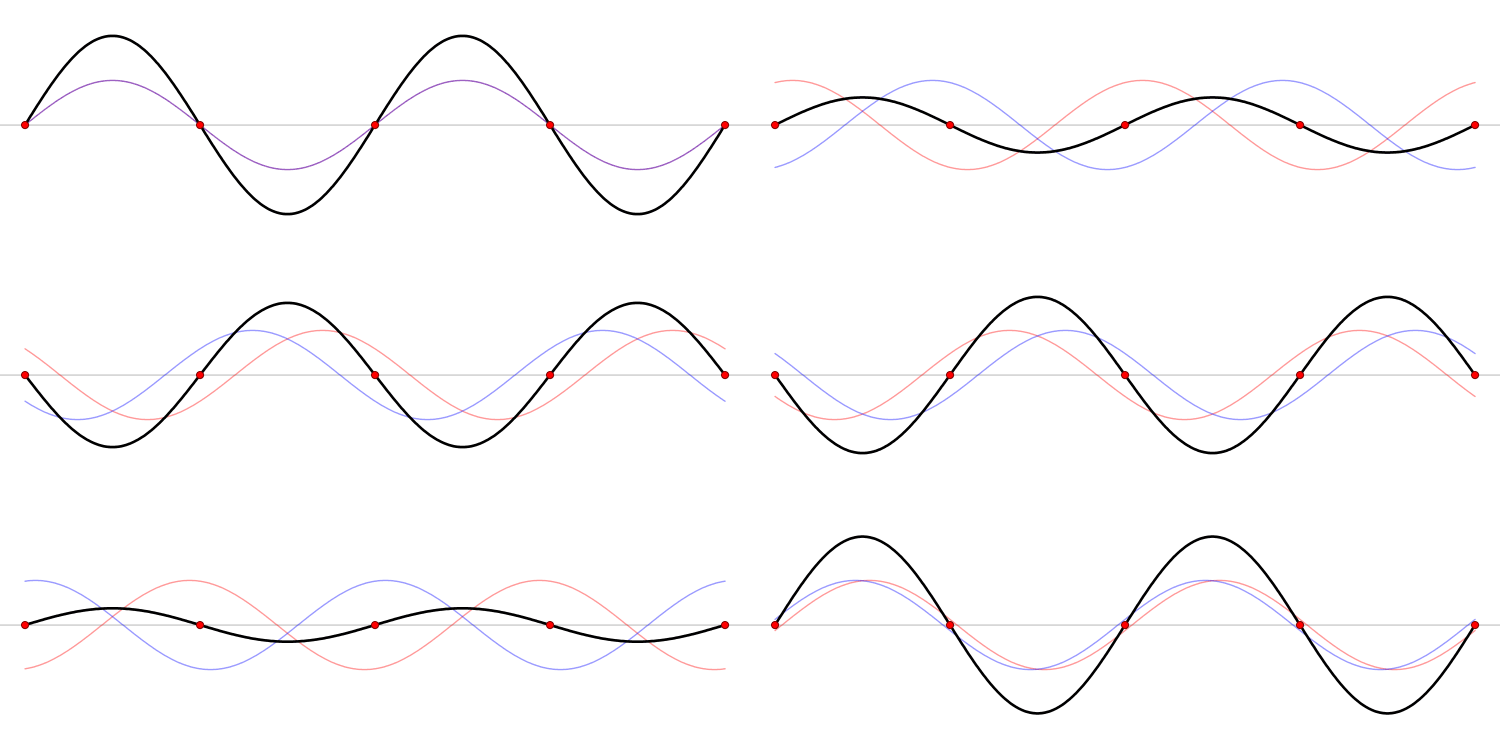

If you have a guitar, try gently brushing a string just above the 12th fret, without pressing it against the fretboard. Pluck it with your other hand and remove the finger that was brushing it. With a little practice, you'll hear a delicate sound, an octave above the open string: a natural harmonic.
Don't worry if it doesn't happen on the first try. Adjust the point of contact and the pressure. The exploration begins in that small change between touching the string and letting it breathe.
From harmonics to the acoustic scale
Now imagine we pause within that series and observe the harmonics from 8 to 14. If we take the eighth as a reference, its proportions are these:
This group resembles the profile of the acoustic scale. Hence its name: there is a kinship between a musical organization and a family of vibrations. John Baez presents this connection as a approximation to the harmonics of a sound.
The word “approximation” deserves to stay with us. That's where this story gets more interesting.
Nature doesn't quite fit on the keys of a piano
In twelve-note equal temperament, the octave is divided into twelve equal semitones. The proportions of the harmonics do not always fit within that grid. UNSW acoustic explanation It points out these differences between the series and tempered tuning.
We can calculate them from the fractions above. A cent is one hundredth of a semitone; an octave has 1,200 cents. Taking C as a reference, three particularly revealing differences appear:
| Proportion | Distance from Do | Comparison |
|---|---|---|
| 11/8 | 551.3 cents | Between F (500) and F♯ (600). |
| 13/8 | 840.5 cents | Between A♭ (800) and A (900); closer to A♭. |
| 14/8 = 7/4 | 968.8 cents | 31.2 cents below Si♭ (1,000). |
So the usual acoustic scale It is not obtained simply by rounding each harmonic to the nearest key. The A is a good example: the 13th harmonic is closer to A♭.
We can think of the scale as a musical map that preserves certain features of that soundscape. A map can guide us without copying every stone along the way.
That doesn't make the scale any less beautiful. It allows us to appreciate both the physical proportions and the decisions we make when creating music.
Two notes change the landscape
If you already know C major, you have a familiar starting point:
Do – Re – Mi – Fa – Sol – La – Si.
To construct acoustic C, raise the F by a semitone and lower the B by a semitone:
1 · 2 · 3 · ♯4 · 5 · 6 · ♭7
When you play it, perhaps the F♯ will suggest spaciousness, surprise, or a light opening up. Perhaps the B♭ will make you feel that the phrase still has something to say. These are images to explore your listening, not emotions that the scale is supposed to produce in everyone.
Rhythm, register, and the way a phrase ends also change the experience. The same collection of notes can become a whisper or a celebration.
Why is it also called dominant fighting?
The name combines two features: the augmented fourth of the Lydian mode and the minor seventh present in a dominant seventh chord. You may also find it as Lydian ♭7 or Mixolydian ♯4; John Baez demonstrates this relationship between Lydian, Mixolydian and acoustic scale.
Another entry point is the ascending melodic minor. G melodic minor contains G, A, B♭, C, D, E, and F♯. If you arrange those same notes around C, you get acoustic C: it's the fourth mode of the melodic minor.
You don't need to memorize all their names today. Choose the explanation that will help you recognize it when you hear it.
A simple practice to listen to your character
1. Give her a place to return to.
Play a low C and let it ring. On a keyboard, you can gently repeat it with your left hand. With another instrument, you can record that note and use it as an accompaniment.
Think of that C as the ground floor of exploration. Every note you play after that will have a relationship to it.
2. Change one thing at a time
Play Do, Re, Mi, Fa, and Sol. Then repeat the phrase with Fa♯. Leave a short silence between the two versions.
Then compare G, A, B, C with G, A, B♭, C. Keep the same rhythm and volume to pay attention to the note change.
3. Construct a short sentence
Try this original melody, slowly:
C – E – F♯ – G | A – G – E – D | B♭ – A – G – C.
The bars only separate ideas; you choose how long each note lasts. Repeat the phrase and change the ending. Then create another one using only four notes of the scale.
Ask yourself where you want to stop, what note compels you to continue, and what changes when you allow more space. The scale begins to truly be yours when you can make decisions with it.
4. Listen to it over a chord
If you play piano, try C and B♭ in a low-middle register, and E and F♯ above it. It's one possible arrangement of Do7(♯11), omitting the fifth. F♯ functions as the augmented fourth moved to the register of the extensions.
The dominant Lydian is a common choice for this type of chord, as shown by the Puget Sound chord and scale relationship chart. The melody and the chords that surround it also matter: use it as a possibility to listen, not as a recipe for any dominant chord.
Frequently Asked Questions
Are the acoustic scale and the harmonic series the same thing?
No. The harmonic series comprises frequencies that are whole-number multiples of a fundamental. The acoustic scale organizes seven notes. Its name indicates a similarity, not an exact identity of pitch.
Is it the same as the harmonic minor scale?
No. The acoustic minor scale has a major third, augmented fourth, and minor seventh. The harmonic minor scale has a minor third, perfect fourth, minor sixth, and major seventh. You can compare both in the table of scale formulas.
Can I play it on a regular piano or guitar?
Yes. The standard version uses the notes available on those instruments. Reproducing certain harmonic ratios exactly is another exploration and may require tuning adjustments.
Do I have to feel like it sounds mysterious?
No. “Mysterious” is a poetic invitation to listen. You might find it joyful, restless, open, or familiar. Your experience doesn't need to fit a label.
The footprint appears when you stop to listen
The acoustic scale can be a gateway to something much broader than learning seven notes. It invites you to move from the act of playing to that of observing: what vibrates, what remains constant, and what happens when you change just a small detail.
Understanding a proportion doesn't replace the emotion of a sentence. It can give you another way to engage with it.
Go back to that first string. Let it ring. Then play a short melody and listen to how the F♯ and B♭ change the course.
Perhaps the most interesting imprint of music is that: something vibrates outside and your way of listening begins to shift.
If you want to continue exploring, check out the Legatto's learning proposals and visit our article library.
Sources and for further exploration
