
Is it really possible to make a living from music?

Is it really possible to make a living from music?
For generations, this question has been accompanied by an almost automatic answer:
“It’s very difficult,” “Musicians don’t earn money,” “You’d be better off studying for a real degree,” or “Music can be a hobby, but not a profession.”.
And if you're a musician, you've probably heard some of these phrases.
Perhaps you have even internalized them.
But today's music world is very different from what it was twenty, thirty or fifty years ago.
Short answer: yes, it is possible to make a living from music.
But making a living from music today doesn't necessarily mean becoming an international star.
It means learning to transform talent, knowledge, creativity, and the relationship with an audience into different sources of value and income.
Why is there this idea that being a musician doesn't pay well?
The belief that Making a living from music is financially difficult It has very deep cultural roots.
For a long time, a music career depended on a fairly limited structure: getting a record label, finding representation, recording, getting into the media, getting distribution, and finally reaching sufficiently large stages.
There were few roads.
Today there are many more.
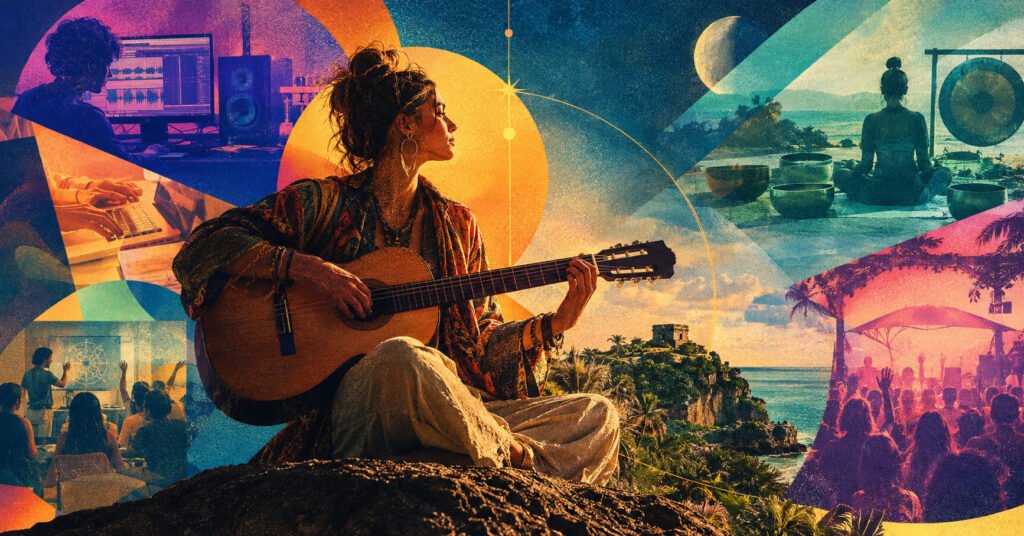
A musician can be a performer, composer, producer, educator, content creator, mentor, sound designer, experience facilitator, course creator, independent artist, or cultural entrepreneur.
And you can combine several of these identities at the same time.
Does family upbringing influence a musician's career?
Lot.
The relationship we develop with money, work, and our own creativity begins long before we start a professional career.
When a child constantly hears that "being an artist doesn't pay well," they may learn to associate creativity with precariousness.
When you hear that artistic talent deserves to be developed and that there is a way to turn it into a profession, the story can be completely different.
Of course, family support makes many things easier: instruments, classes, studies, travel, time to practice, and stability during the early years.
But it's not an absolute requirement either.
There are musicians who grew up with enormous resources and never built a sustainable career, while others started practically from scratch and developed extraordinary communities, businesses, and artistic proposals.
The difference usually appears in a combination of
skill, perseverance, education, relationships, vision, and ability to recognize opportunities.

Is the music industry really growing?
Yeah.
And the current data is quite interesting.
According to the IFPI Global Music Report 2026, Global recorded music revenues reached a record high. US$$31.7 billion in 2025, growing 6.4% compared to the previous year.
Furthermore, all regions of the world registered growth.
World
Growth of recorded music in 2025
Latin America
Region with the highest growth
Mexico
Growth during 2025
Latin America was the fastest growing region, with an impressive 17.1%.
Mexico grew 13.3% and reached ranked number 10 among the world's largest music markets.
Streaming also accounts for 88.11% of Latin America's recorded music revenue.
You can check the data directly in the
IFPI Global Music Report 2026.
And what's happening in the United States?
The United States continues to be the world's largest music market.
According to the
RIAA,
Wholesale revenues from recorded music in the United States reached approximately US$$11.5 billion in 2025.
Streaming alone generated approximately US$9.47 billion, a growth of 3.1% compared to 2024.
This reveals something important:
The music industry is not disappearing.
It's changing.
And when a market changes, new ways of participating in it emerge.

Is it possible to make a living from Spotify?
This question deserves a careful answer.
Yes, there are artists who generate significant income directly from streaming.
But for most musicians, building a sustainable career solely from streaming royalties shouldn't be the only strategy.
The data published by Spotify in
Loud & Clear
show that by 2025 more 81,000 artists generated at least US$1,441,000 on Spotify alone.
More than 13,800 artists surpassed US$100,000 and more than 1,500 surpassed US$1 million in Spotify royalties.
Spotify also notes that approximately half of its royalties were generated by independent artists and labels.
But there is a fundamental distinction:
These numbers correspond to Spotify royalties, not to the artist's total income.
A professional musician can use their audience to generate additional income through concerts, products, collaborations, education, experiences, branding, memberships, and services.
So how can a musician make money?
This is where things get really interesting.
Instead of thinking of a single source of income, we can imagine a music career as a ecosystem.
1. Online Education
Courses, masterclasses, group programs, memberships, and mentorships allow us to turn years of musical knowledge into educational products and services.
A musician can teach instrument, harmony, composition, improvisation, production, ear training, singing, or develop their own methodology.
2. Specialized Mentoring
Experience also has value.
Musicians with a particular background can accompany other artists in composition, performance, production, creativity, professional career or project development.
3. Music production and services
Production, arrangements, composition for audiovisual, sound design, remote recording, mixing, editing and music for brands are services that can be offered internationally.
The internet allows a musician to work with clients who live thousands of miles away.
4. Music + Wellness
Retreats, sound baths, immersive experiences, meditation, yoga, wellness hotels, and sound experiences are creating new professional spaces for musicians and facilitators.
Here, music ceases to be mere entertainment and becomes an experience.
5. Experiences and communities
Intimate concerts, musical circles, workshops, festivals, gatherings and communities can become sustainable economic models.
The value is no longer just in the song: it's in the experience of sharing it.
6. Synchronization and creation for media
Movies, series, video games, advertising, podcasts, installations and digital content all need music.
Media composition can become a particularly interesting career path for musicians who prefer to work behind the scenes.

Why is the market for courses and mentorship interesting for musicians?
Because the musician already possesses something that many industries have to buy:
specialized knowledge built up over years.
A person can spend ten years studying harmony, instrument, composition, or production.
That knowledge can remain solely within their own practice.
Or it can become a methodology that helps hundreds of people.
Digital education enables precisely that transition.
A course can be sold many times.
A masterclass can reach people from different countries.
Mentoring can be done from anywhere.
And a community can turn into a long-term professional relationship.
At Legatto we explore precisely this idea from a different perspective:
music education as a living experience,
where theory, practice, creativity, listening, and experience meet.

Why can wellness be an opportunity for musicians?
Because the relationship between music, experience, and well-being is growing within a huge economy.
He
Global Wellness Institute
It is estimated that the global wellness economy reached approximately US$$6.8 trillion in 2024 and projects that it will reach almost US$1.4 trillion by 2029.
Wellness no longer only represents spas or gyms.
It includes tourism, experiences, mental health, spaces, contemplative practices, and many other wellness-related industries.
This opens up possibilities for musicians capable of working with sound in a professional and responsible manner:
sound baths · meditative music · retreats · immersive experiences · collective singing · sound installations · wellness hotels · festivals · relaxation experiences
The opportunity is not simply about learning to play an instrument used in a sound bath.
It consists of developing an experience that has
musical quality, intention, structure, sensitivity, and real value for the public.
Do you need to be famous to make a living from music?
This is probably one of the most important ideas.
No.
The digital economy is creating something that was much more difficult before: the possibility of building a career around a relatively small but deeply connected audience.
You don't need millions of people to know you.
You need to find the right people.
A community of 100 people who truly value your work can be more meaningful to an independent musician than a huge audience that never buys, engages, or connects with their music.
In fact, Spotify data shows that more than 801% of the artists who generated more than US$1 million on Spotify during 2025 did not have a Top 50 hit.
The music world is becoming more diverse.
And that's good news for artists who have something of their own to say.

What is the real change for the 21st-century musician?
Perhaps it's not about learning how to make money with a song.
It's about learning to build a ecosystem around music.
A song can attract a person.
A concert can create a connection.
A course can transmit knowledge.
Mentoring can transform a career path.
A community can create a sense of belonging.
An experience can become a memory.
And all these things can be part of the same career.
The new question for a musician might not be:
“"How can I make a living playing music?"”
But:
“"How can I create an abundant life around all that I know, feel, and can offer through music?"”
So, is it really possible to make a living from music?
Yeah.
But probably not in the way we were taught to imagine it.
Making a living from music can mean playing.
It can also mean to teach.
Produce.
Compose.
Create experiences.
Accompanying other artists.
Working with wellness.
Create a community.
Develop a methodology.
Build an international audience.
Or combine five or six of these things to create your own economic structure.
Music is still art.
But it can also be knowledge, service, experience, profession, and community.
Abundance appears when our talent finds a real way to serve the world.
Music can become a path
At Legatto we explore music from a perspective that integrates
technique, intuition, listening, creativity and awareness.
You can learn about our
music classes and experiences,
explore our proposal
music education
or discover tools like
Scale Studio.
Frequently asked questions about making a living from music
Is it possible to make a living from music?
Yes. A musician can generate income through performing, composing, producing, teaching, mentoring, online courses, experiences, wellness, synchronization, creative services, and communities. The key is building a sustainable mix of income streams.
How to make money with music?
Options include concerts, streaming, classes, courses, mentoring, music production, composition, music for audiovisual media, sound baths, retreats, musical experiences, memberships, and creative services for other artists or companies.
Do I need to be famous to make a living from music?
No. A musician can build a sustainable career around a small but engaged audience. The digital economy allows musicians to reach international audiences without relying exclusively on major record labels or traditional media.
Is it profitable to teach music online?
This can happen when knowledge is transformed into a clear educational offering. Courses, masterclasses, group programs, and mentorships allow a musician to transform their experience into educational services and products that can reach students in different locations.
Does music have opportunities within wellness?
Yes. The expansion of the wellness economy is creating spaces for musical experiences, retreats, sound baths, meditation, wellness hotels, immersive experiences, and other offerings related to sound and well-being.
What is the best source of income for a musician?
There is no single ideal revenue stream for everyone. A more robust strategy typically combines different income streams: for example, presentations and production with online education, mentoring, creative services, or experiences.
