
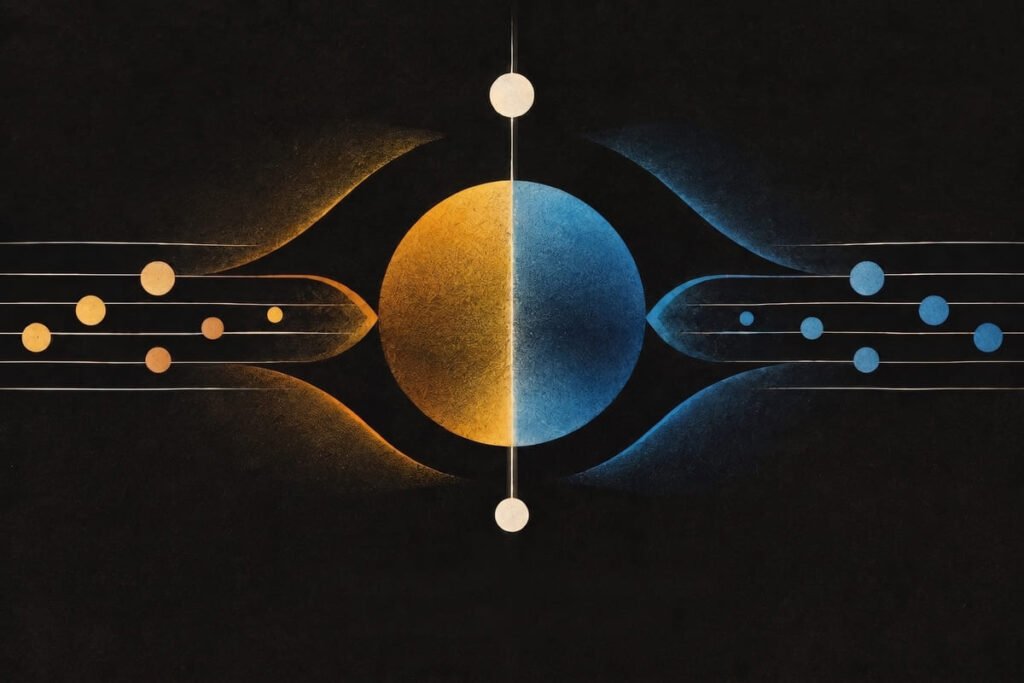
Introduction to Negative Harmony – The Mirror of Harmony
That, in essence, is what it explores. negative harmony: a way of transforming notes, chords and progressions through a symmetry relationship around a tonal axis.
Instead of starting with a long theoretical explanation, let's build it visually.
First: think of a mirror
Let's suppose we are in C major.
The main reference point is C. Its fifth is G. Between the two we can imagine an axis of symmetry.
The axis of reflection is located between Mi♭ and Mi
Each note is reflected at the same distance on the other side of the axis.
A practical way to find that axis is to use the circle of fifths. In C major, the axis is placed between the tonic and the dominant, that is, between C and G. By reflecting the notes across this axis, each one finds its corresponding "negative".
This idea is related to the theory of harmonic polarity of Ernst Levy. The term “negative harmony”, on the other hand, was coined later by the saxophonist and composer Steve Coleman, who developed his own ideas of tonal symmetry from the late 1970s.
The map: seven notes facing its reflection
Now comes the interesting part.
If we place the notes of C major around our axis, we can observe which note is opposite which:
C ↔ G · D ↔ F · E ↔ E♭ · A ↔ B♭ · B ↔ A♭
Notice something particularly beautiful: Mi becomes Mi♭.
The major third is reflected as a minor third.
This helps to understand why negative harmony can produce such a profound change of character without completely abandoning the feeling of belonging to the same tonal center.
Now let's reflect a chord
Let's take the simplest chord possible:
C – E – G
C – E♭ – G
The chord C major contains:
C – E – G
By reflecting each of those notes we obtain:
G – E♭ – C
Rearranged, those same notes form:
C – E♭ – G = Cm
That's why one of the most intuitive results of negative harmony is that a major chord can find a equivalent lower in the reflection.
The example that really clicks: G7 → Fm6
Now let's do something more interesting.
In C major, the chord G7 It is the dominant one. It is made up of:
G – B – D – F
We reflect every note:
G – B – D – F
F – A♭ – C – D
The transformation is:
| Original note | Distance to the axis | Reflection |
|---|---|---|
| G | 3 semitones to the right | C |
| B | 5 semitones to the right | A♭ |
| D | 2 semitones to the left | F |
| F | 1 semitone to the right | D |
Complete reflection map (12 notes)
The axis is between E♭ and E. Each note is reflected at the same distance on the opposite side.
The result is C – A♭ – F – D, which we can reorganize as Fm6.
And here appears one of the most interesting applications of the concept:
↓
Fm6 → C
Two different paths to the same tonal center.
Negative progression doesn't simply change "major to minor." It can also produce a new voice leading and another way of experiencing the pull toward the tonic.
The most powerful visual tool: the circle of fifths
If you want to experiment with negative harmony, this is probably the most useful image to have in front of you.
Circle of fifths — axis at C
| Original | ↔ | Negative | Distance to the axis |
|---|---|---|---|
| C | ↔ | G | ±5 semitones |
| G | ↔ | C | ±5 semitones |
| D | ↔ | F | ±3 semitones |
| A | ↔ | B♭ | ±3 semitones |
| AND | ↔ | E♭ | ±1 semitone |
| B | ↔ | A♭ | ±5 semitones |
| F | ↔ | D | ±3 semitones |
The idea can be visualized as a kind of folding of the circle: the notes that are on one side of the axis find their partner on the other side.
This spatial way of thinking is especially close to the way Steve Coleman has described his own systems of musical symmetry: not just thinking in terms of chord names, but learning to imagine movements within a tonal space.
From one note to a complete progression
Once you have the map, you can transform an entire progression.
Original progression
Dm7 → G7 → Cmaj7
Negative reflection
Bb6 → Fm6 → Cm7
The important thing here is not to memorize this sequence like a recipe.
The interesting thing is being able to see what happened:
Define the center and the axis of reflection.
You don't change the entire chord at once: you transform its notes.
You discover which chord appears.
Theory shows you a possibility; your ear decides what to do with it.
Why does it sound different if we're still in the same center?
Here is one of the most interesting ideas of negative harmony.
The transformation preserves certain functional relationships, but changes the direction of some movements. A note that previously tended to rise may now exhibit a downward trend.
It's like changing the direction of gravity without completely moving the landscape.
It consists of reflecting tonal relationships around an axis.
That's why it's related to ideas of polarity, symmetry and harmonic duality. Levy's theory proposes precisely a relationship between the major and minor poles within a broader conception of harmony.
Jacob Collier and the popularization of negative harmony
If you've come across negative harmony through the internet, it's very likely that you first encountered Jacob Collier.
Collier helped bring this concept to a new generation of musicians through interviews, masterclasses, and online explanations. In his own explorations, he speaks of negative harmony as a way to find a “reflection” of a progression and discover new routes to the tonal center.
His relationship with this concept is part of a larger story. Ernst Levy's idea of polarity predates it, while Steve Coleman developed and named symmetry systems that he later connected to Levy's ideas.
You can learn more about his musical language and his explorations of harmony, microtonality, and rhythm in our article on Jacob Collier: the revolution of modern music.
Negative harmony as a creative tool
Perhaps the most interesting question is not "what negative chord corresponds to this chord?".
The question could be:
What happens if I look at my harmony from the other side?
Try this little experiment.
1. Choose a progression you already know
It could be a four-chord progression from a song, a loop from your DAW, or a sequence you've composed.
2. Define the tonal center
Identify the tonic and the fifth. That will be the space around which you will build the axis.
3. Convert the notes, not just the names
Find the reflection of each note within the map. Then rebuild the chords.
4. Play both versions
First, listen to the original progression.
Then comes its negative version.
Finally, try something much more interesting: mix both.
Perhaps you simply want to replace a chord. Perhaps you want to use a negative note within a conventional melody. Perhaps you'll discover a completely new transition.
Negative harmony does not have to replace traditional harmony
This point is important.
Negative harmony works best understood as an additional composition and exploration tool. You don't need to choose between "positive harmony" and "negative harmony." You can move between both.
A progression can begin conventionally, introduce a negative chord, return to the original harmony, and then use only a reflected note as a melodic color.
The real tool is not the system.
It's about learning to see more possibilities within the same musical space.
Frequently Asked Questions
Who invented negative harmony?
The story is more interesting than a single author. Ernst Levy He developed a theory of harmonic polarity related to these principles. The saxophonist and composer Steve Coleman He used and developed concepts of tonal symmetry and coined the term “negative harmony”. Decades later, Jacob Collier It greatly contributed to popularizing it among a new generation of musicians.
Is negative harmony the same as inverting a melody?
Not exactly. Both ideas use symmetry relationships, but negative harmony defines a specific tonal axis and reflects the notes around that axis. That's why it can produce different harmonic equivalents from a simple melodic inversion.
Does negative harmony always turn a major chord into a minor one?
Not as an isolated rule. In certain structures, such as the major triad, reflection produces its minor counterpart. But when you reflect more complex chords, the result can be another type of chord, as with G7 → Fm6.
Do I need to know advanced music theory?
Not to begin with. You need to understand a key, recognize basic notes and chords, and above all, have an instrument or tool with which you can experiment.
Is negative harmony really “natural”?
The relationship between negative harmony, harmonic series, subharmonics, and harmonic dualism is part of a complex theoretical history. It is more accurate to speak of a Theoretical interpretation of polarity and symmetry relationships than to claim that negative harmony is a physical law of nature.
True power lies in the mirror
Negative harmony can seem mysterious when we find it written as a collection of rules.
But when we place it visually in front of us, something much simpler appears:
A tone.
↓
An axis.
↓
A reflection.
↓
New relationships.
And perhaps that's the best way to start exploring it.
Don't memorize first.
Draw.
Place the notes in space. Find the axis. Reflect one. Then another. Build the resulting chord.
And finally, listen.
Because when a musical theory becomes a visual tool, it ceases to be merely something you can explain.
It becomes something you can explore.
If you want to delve deeper into the possibilities of harmony, composition, and the relationships between sound, proportion, and geometry, you can explore the Legatto's learning proposals and our article library.
Sources and for further exploration
