
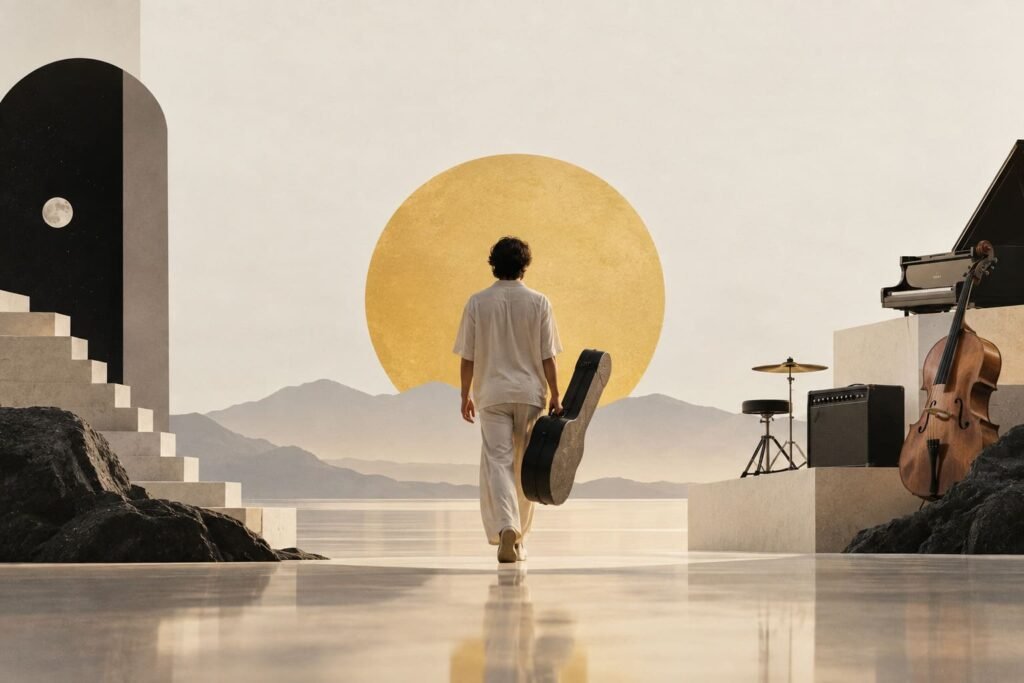
How to make a living from music and not die trying
For generations, one of the most repeated phrases to those who want to dedicate themselves professionally to music has been:
“"It's great as a hobby, but you need something you can make a living from."”
The phrase stems from a reality: building an artistic career requires time, preparation, and strategy. But it also belongs to an outdated way of understanding the music profession.
For much of the 20th century, it seemed that there were only a few paths: get a record deal, join an orchestra, play constantly, become a teacher, or achieve enough fame to live off record sales.
Today the landscape is completely different. A musician can be a performer, composer, producer, educator, digital creator, arranger, session musician, mentor, sound designer, or several of these things simultaneously.
Direct answer Yes, it is possible to make a living from music. For a large part of 21st-century musicians, the most sustainable strategy is to combine various sources of income around their skills, their catalog, their knowledge, and their community.

Is it really possible to make a living from music?
Let's start with the numbers.
According to the
IFPI Global Music Report 2026,
Worldwide revenues from recorded music reached approximately
$31.7 billion in 2025. Latin America once again stood out as one of the fastest growing regions, advancing 17.11%3T.
Mexico also gained greater weight within the global market, entering among the ten largest recorded music markets in the world.
Estimated global revenues of recorded music in 2025 according to IFPI.
Reported growth of Latin America during 2025.
Position achieved by Mexico among the largest global markets for recorded music.
This reveals an important paradox:
The question should no longer be only “Is there money in music?”. Obviously there is.
The most useful question is:
How does a musician build a sustainable stake within that economy?
The big mistake: thinking that making a living from music means living solely off Spotify
Streaming can become an important source of income and discovery, but for many artists it works best as one piece within a larger ecosystem.
According to
Spotify Loud & Clear,
Tens of thousands of artists achieve significant royalty levels on the platform each year. Spotify has also noted that a considerable portion of those who reach high incomes never had a song chart on the main global charts.
This shatters a particularly harmful idea:
Having a music career and becoming a global celebrity are different things.
There is a huge professional gap between playing occasionally and filling stadiums.

Stories of artists who changed the rules
The most interesting musical careers rarely follow exactly the same path. Observing very different cases helps to discover principles that can be applied without copying anyone's career.
History 01
Jacob Collier: When fans also build the visual universe
Jacob Collier is a prime example of how a community can become more than just an audience. His music has spawned videos, animations, visual pieces, and fan-created collaborations that expand the imagery of his songs.
One of the clearest examples is the participatory culture surrounding his work: from audiovisual projects born online to videos where the community contributes material, voices, faces, or visual ideas that then become part of the artistic narrative. Instead of treating his followers merely as spectators, Collier has built a relationship where many of them also feel invited to create.
Teaching is powerful:
When a musical identity awakens collective imagination, fans not only help spread the work; they can expand its visual, emotional, and creative world.
Reading:
Medium — The Road to Moon River.
Story 02
Russ: turning consistency into a catalog
Russ spent years producing, recording, mixing, and mastering his own music. He released numerous projects with modest results before completely changing his strategy.
In late 2014, he began releasing roughly one song per week on SoundCloud. He kept up that pace for over a year and gradually built the audience he needed to turn his catalog into a career.
The great lesson:
A song is not just content. It can become intellectual property capable of continuing to create value for years.
Fountain:
Forbes — Meet Russ, Hip-Hop's Newest 10-Year Overnight Success.
History 03
Chance the Rapper: Independence means retaining decision-making power
Chance the Rapper built much of his professional identity outside the traditional model of a major record label.
That never meant working in isolation. His career has included distribution, platforms, collaborations, teams, and commercial agreements. In 2017, he confirmed a deal with Apple Music that included US$1,445,000 and promotion in exchange for temporary exclusivity. Coloring Book.
Professional independence can be best understood as
the ability to choose your alliances without automatically surrendering complete control of your project.
Fountain:
Forbes — Chance the Rapper and Apple Music.

History 04
Amanda Palmer: a community can fund a project
In 2012 Amanda Palmer launched a Kickstarter campaign to fund a new album, an art book, and a tour.
Their initial goal was US$1,440,100,000. The campaign ended up raising
US$1,192,793 of 24,883 people.
Beyond the number, the case helped to demonstrate something essential for the contemporary musician:
An audience can evolve into a community willing to participate directly in the existence of a work.
Fountain:
Kickstarter — Amanda Palmer.
History 05
Pomplamoose: a musical project can also become a small creative business
Pomplamoose began with Nataly Dawn and Jack Conte producing music and videos in a relatively homey and straightforward way.
Over time, that creative core was able to expand into recordings, guest musicians, audiovisual content, performances, and a direct relationship with fans.
Learning is especially useful:
Professionalizing a musical project does not mean eliminating its personality; it means building infrastructure so that it can continue to exist.
You can learn about their current model at
Pomplamoose Patreon.
The 21st-century musician has a portfolio career
One of the most useful ideas for understanding the current profession is the
portfolio career.
Instead of imagining a single occupation, think of several professional skills that feed off each other.
INTERPRETER + CREATOR + PRODUCER + EDUCATOR + ENTREPRENEUREach musician creates their own combination. What's important is that the different activities belong to the same professional sphere.
Institutions such as
Berklee College of Music
They currently describe dozens of professions within the music ecosystem: performance, composition, production, technology, songwriting, business, administration, education, sound design and many more.
At Legatto, we also understand musical training from a broad perspective. Our
musical methodology
It integrates listening, theory, creation, sound exploration, and the development of one's own language.
8 ways to make money with music
The goal isn't to do them all at once. The idea is to understand the field and choose the ones that make the most sense for your personality, skills, and project.
01
Presentations
Concerts, festivals, venues, hotels, private events, weddings, corporate events, escorting, sessions and tours.
02
Education
Private lessons, workshops, ear training, theory, instrument, voice, composition, production and educational programs.
03
Production
Recording, composition, arrangements, beatmaking, editing, mixing, mastering, programming and comprehensive production.
04
Royalties
Streaming, composition, publishing, public performance rights, masters and other forms of intellectual property.
05
Synchronization
Music for films, series, documentaries, advertising, video games, trailers and audiovisual content.
06
Direct sales
Albums, vinyl records, sheet music, presets, samples, merch, physical editions, materials and digital products.
07
Community
Memberships, crowdfunding, exclusive content, clubs, private experiences, and recurring support.
08
Experiences
Retreats, immersive experiences, collective singing, deep listening, installations, sound baths and wellness contexts.
1. Teaching music can be an extraordinary creative career
Teaching remains one of the most accessible ways to turn musical knowledge into a professional activity.
But contemporary music education is no longer limited to a typical weekly instrument lesson.
A musician can teach:
- instrument;
- voice;
- composition;
- auditory training;
- harmony;
- improvisation;
- music production;
- songwriting;
- rhythm;
- arrangements;
- music software;
- sound synthesis and design.
In addition, the internet allows working with students who live in other cities or countries.
You can explore the
Legatto's classes and educational experiences
to observe different ways of approaching contemporary music teaching.

2. Courses, workshops and mentoring
A class, a course, and a mentorship address different needs.
A class typically exchanges knowledge and guidance for time. A workshop focuses on a specific experience. A course organizes knowledge within a methodology. Mentoring incorporates diagnosis, experience, and personalized follow-up.
Knowledge accumulated over years can become valuable to someone who is a few steps behind.
That's why a producer can teach workflow; a composer can guide composition processes; an experienced performer can work on identity, technique, and repertoire.
Even something seemingly specialized can be transformed into an educational offering. For example, at Legatto we explore different musical systems within our content on
Musical Scales of the World.
3. Music production and services
Every musician develops skills that other people may need.
Your artistic project may take years to reach its full potential, but you can become an excellent arranger, producer, editor, or session musician much sooner.
Among the professional music services we offer are:
- remote instrument recording;
- production;
- vocal editing;
- arrangements;
- transcription;
- orchestration;
- mixing and mastering;
- commissioned composition;
- sound design;
- creating music for other artists.
4. Understanding music rights changes your career
A song is music, but professionally it can also become intellectual property.
A work may involve rights related to:
- composition;
- letter;
- publishing;
- master recording;
- public execution;
- reproduction;
- distribution;
- synchronization.
Understanding who owns each item is fundamental before signing contracts, dividing percentages, or transferring a catalog.
Berklee even offers training specifically dedicated to the
revenue streams of the music business.
5. Direct selling: One hundred committed people can be worth more than thousands of distracted spectators
Streaming and social media allow you to reach huge audiences. Direct sales develop a different kind of relationship.
According to
Bandcamp,
around On average, 82% of the money from a purchase made on the platform reaches the artist or label. after your participation and processing costs.
Bandcamp also reports that fans have paid billions of dollars directly to artists and labels through its platform.
An artist can sell:
- digital music;
- vinyl records;
- CDs;
- cassettes;
- sheet music;
- merch;
- limited editions;
- sample packs;
- educational material.
Platforms like
Patreon
They add another possibility: transforming particularly committed followers into recurring members of a community.
6. Music, experiences and wellness
There is also a growing territory where music, listening, and wellness experiences are beginning to converge.
Opportunities arise there around:
- sound baths;
- withdrawals;
- sound meditation;
- immersive experiences;
- collective singing;
- yoga and music;
- sound installations;
- deep listening;
- hotels and retreat centers.
These activities require training, sound judgment, and responsibility, especially when making health-related claims. Music can be part of wellness experiences but should not be considered a substitute for medical treatment.
The economic context, however, is considerable.
Global Wellness Institute
He estimated that the global wellness economy reached approximately
US$1,446.8 trillion in 2024 and projects around US$1.4 trillion by 2029.

The formula that changes everything: Audience × Value × Relationship
Many musicians try to solve their entire financial problem by focusing solely on reach:
“I need more followers.”
But thousands of followers who never participate financially can generate less value than a much smaller, deeply connected community.
AUDIENCE × VALUE × RELATIONSHIPReach allows someone to discover your work. Value gives them a reason to engage. Relationships make a long-term career possible.
Audience
How many people know you exist?
Worth
What else can you offer besides free content?
Relationship
How many people trust your project enough to buy a record, a ticket, a class, an experience, or support your creative process?
Don't just build followers. Build your own channels.
Instagram can change its algorithm. TikTok can change its rules. Spotify can modify its tools. YouTube can transform its recommendation system.
That's why it's advisable to build assets that progressively belong to your own ecosystem:
- website;
- mailing list;
- contact database;
- community;
- catalog;
- store;
- audiovisual archive;
- intellectual property;
- professional relationships.
How much do you really need to make a living from music?
This question is usually much more useful than asking yourself:
“"How do I become famous?"”
Let's simply imagine, as an exercise, that a musician wants to build approximately
$30,000 MXN monthly.
A hypothetical ecosystem might look like this:
| Activity | Hypothetical monthly income |
|---|---|
| Classes and mentoring | $8,000 |
| Presentations | $8,000 |
| Production / sessions | $6,000 |
| Workshop or course | $4,000 |
| Catalog / Royalties / Sales | $2,000 |
| Community / Products | $2,000 |
| Total | $30,000 |
This does not constitute a price recommendation or a promise of income.
It's simply a mathematical proof:
No single source needs to become an extraordinary phenomenon for the entire system to begin functioning.
The three levels of a sustainable music career
1. Active income
You directly exchange time and professional skills for money.
Examples: classes, concerts, sessions, production and consulting.
2. Scalable income
You create something that can be used or sold more than once.
Examples: courses, sheet music, presets, samples, books, licenses, and digital products.
3. Long-term assets
They are elements capable of continuing to generate opportunities over time.
Examples: catalog, compositions, own audience, rights, reputation, community and brand.
90-day plan to start making a living from music
The solution is hardly to launch eight businesses simultaneously.
You can start with a much smaller system.
1–30
Define what you know how to do
Make three lists: what you do well, what you enjoy, and what other people need. Look for intersections between the three.
31–60
Create a specific offer
“I’m a musician available” doesn’t tell you much. “I produce string arrangements for singer-songwriters” or “I teach ear training for producers” immediately lets you understand what problem you solve.
61–90
Build a small system
Publish useful content, establish a way to contact people, present a clear offer, and start developing a relationship with those who find value in your work.
Your ecosystem can be surprisingly simple
DISCOVERY → TRUST → OFFER → RELATIONSHIPYou don't need a digital empire. You need a clear path for someone to discover you, get to know you, and ultimately work with you or support your music.
For example:
Educational video → article → mailing list → workshop → private class → mentoring.
EITHER:
Song → concert → community → merch → crowdfunding → next album.
EITHER:
Portfolio → client → production → recommendation → recurring work.
Do you need millions of followers?
To build a professional career, not necessarily.
You need enough of the right people around a value proposition.
A musical economy can be built with combinations such as:
- 20 recurring students;
- 10 production clients;
- 200 people buying tickets;
- 100 people buying a course;
- 50 members of a community;
- a catalog accumulating royalties;
- a combination of several of the above.
That's why it's advisable to obsessively replace the question
“How many followers do I have?”
On the other hand:
Do I also have to become an entrepreneur?
To some extent, developing a profession means understanding how your activity works economically.
This implies knowing:
- how much does it cost to produce your work;
- how much you need to generate;
- What is the value of your time?;
- who owns your rights;
- which activities work;
- what type of audience connects with your proposal;
- what you want to keep under your control.
Learning business doesn't have to replace your artistic sensibility.
In fact,
Understanding the business can protect your creativity by giving you greater choice.
You also need to learn to say no.
Some opportunities have a value that goes beyond immediate money.
A low-paying gig can be interesting when:
- connects you with a relevant audience;
- produces excellent audiovisual material;
- opens an important professional relationship;
- It has enormous creative value;
- It represents a concrete strategic investment.
But permanent exposure hardly replaces an economic model.
Learn to differentiate between
strategic investment and recurring free work.
And what about Artificial Intelligence?
AI is transforming production, composition, editing, mixing, sound design, marketing, and content creation.
For the 21st-century musician, probably the most productive response is to learn to use new tools while continuing to strengthen what makes their work recognizable.
Tools can speed up tasks.
But judgment, sensitivity, interpretation, intention, listening, experience, and human relationship continue to have enormous value.
The musician of the future will probably be more human, not less.
There is an understandable fascination with tools.
But one of the most difficult elements to reduce to technology continues to be the ability to produce a meaningful experience between people.
A concert.
An unforgettable class.
An improvisation.
A community.
A conversation.
A song that arrives precisely when someone needed to hear it.

So… how to make a living from music and not die trying?
Perhaps the complete guide can be condensed into a few ideas.
Make music.
And learn to communicate it too.
Develop your instrument.
And it develops skills that other people value.
Build an audience.
And gradually turn it into a community.
Publish songs.
And it includes the rights related to them.
He plays concerts.
And explore other ways to put your skills to use.
Learn technology.
And continue strengthening your identity.
Work for your work.
And build a life that allows you to continue creating it for many years.
A new way to learn and experience music
At Legatto we understand musical training as something broader than simply mastering an instrument.
Listening, understanding, creating, improvising, experimenting and developing your own language are all part of the same experience.
You can find out
Legatto's methodology,
explore our
music classes and experiences
or experiment directly with
Scale Studio.
Frequently asked questions about making a living from music
Is it possible to make a living from music without being famous?
Yes. Many musicians build professional careers through a combination of concerts, teaching, production, songwriting, sessions, licensing, direct sales, courses, and other activities without becoming celebrities.
What's the fastest way to start making money as a musician?
For many musicians, direct services such as lessons, sessions, production, and performances have a relatively accessible barrier to entry because they can start with skills they already possess.
Is it possible to make a living solely from Spotify?
Some artists earn high incomes through streaming, but for many musicians it is more sustainable to combine royalties with various sources of income.
What jobs can a musician do besides playing music?
A musician can work as a teacher, composer, arranger, producer, session musician, sound designer, musical director, transcriber, course creator, mentor, and synchronization professional, among many other options.
Is it worth being an independent musician?
It depends on the project. Independence offers greater decision-making power and potentially greater control over rights, while partners, labels, and distributors can provide funding, infrastructure, promotion, and contacts.
How many sources of income should a musician have?
There is no universal number. To begin with, two or three complementary resources developed consistently are usually much more manageable than trying to build numerous activities simultaneously.
Is it a good idea to teach while developing my art project?
Yes. Education can provide income, deepen your own knowledge, and help finance the development of an artistic project.
Do I need to study a music degree to make a living from it?
There is no single career path. Academic training can provide structure, knowledge, networks, and specialized practice, while many professionals also build their careers through independent learning, mentorship, and practical experience.
How much money can a musician earn?
It varies enormously depending on the country, specialty, experience, intellectual property, demand, audience, and professional model. That's why it's usually more useful to design several revenue streams than to look for a universal figure.
Will Artificial Intelligence replace musicians?
AI is transforming many tasks related to music and production, but performance, artistic judgment, live experience, identity, and human connection remain a core part of a musician's professional value.
Recommended sources and readings
- IFPI—Global Music Report 2026.
Global data on the recorded music industry and regional growth. - RIAA — Year-End Music Industry Revenue Report.
Data from the US market. - Spotify — Loud & Clear.
Information on royalties and the economics of streaming. - Berklee College of Music — Careers in Music.
Overview of professional careers within music. - Berklee Online — Music Business Revenue Streams.
Training on income sources within the music business. - Bandcamp — About / Direct-to-Fan Model.
Data on direct sales to followers. - Patreon — Paid Memberships.
Recurring membership model for creators. - Global Wellness Institute — 2025 Global Wellness Economy Monitor.
Size and projections of the global wellness economy. - Forbes—Russ: 10-Year Overnight Success.
History of Russ's independent development. - Forbes — Chance the Rapper & Apple Music.
Information about your temporary exclusivity agreement. - The Guardian — Jacob Collier and the audience choirs.
History of his participatory concerts and the use of fan voices in his work. - Kickstarter — Amanda Palmer.
Historical case of musical crowdfunding. - Pomplamoose — Patreon.
A contemporary example of community and direct support.
